
Enamela Review: How We Run Three Dental Clinics in Karachi on One System
Medically reviewed byDr. Saad IrfanMDS, MSc, BDS·
Key Takeaways
- 1All three branches moved from paper registers to Enamela on 1 October 2026, with one patient record shared across DHA Phase 5, DHA Phase 8 and Clifton
- 2Online booking, numbered walk-in tokens and a waiting room TV screen changed the front desk more than any clinical feature
- 3The tooth chart records caries by depth, cavitation, activity and radiographic depth, with six-site perio charting and pulp tests
- 4Braces and aligner cases are tracked as courses, with wires, elastics, trays and the remaining balance on one screen
- 5Sending reminders automatically from the clinic's own WhatsApp number is not live yet
- 6Disclosure: we were the first clinic to trial Enamela, we now pay for it, and its founder also works on this website
We moved all three of our clinics, DHA Phase 5, DHA Phase 8 and Clifton Block 9, onto Enamela on 1 October 2026. Six weeks in, every appointment, chart, bill and recall for all three branches lives in one browser tab, and nobody goes looking for a patient's file in a cupboard any more. In fifteen years of practice I have not worked on a more complete clinic system. This is what it does well, where it is still thin, and who I think it suits.
Disclosure
We were the first clinic to trial Enamela, before it was offered to anyone else, and we now pay for it like any other clinic. Enamela's founder, Noman Hassan, also works on our clinic's website. Nobody paid for this review and the opinions are mine.
What running three branches looked like before
Paper. A register at each front desk, a file for each patient, and a great deal of memory.
The problems were ordinary ones. A patient who had a filling at Phase 5 would walk into Clifton a year later and nobody there could see what had been done. Finding last year's notes meant finding last year's folder. If a patient asked what we had done on a particular tooth, the honest answer was sometimes "let me check", followed by ten minutes of checking. When three branches each keep their own paper, the practice as a whole remembers less than any one of its receptionists.
One board for DHA Phase 5, DHA Phase 8 and Clifton
The Schedule board is the screen our front desks live on. Each branch has a tab, and each patient card moves across five columns through the day: Upcoming, Waiting, In chair, Bill and check out, Done. A side panel shows which chairs are free and which doctors are online.
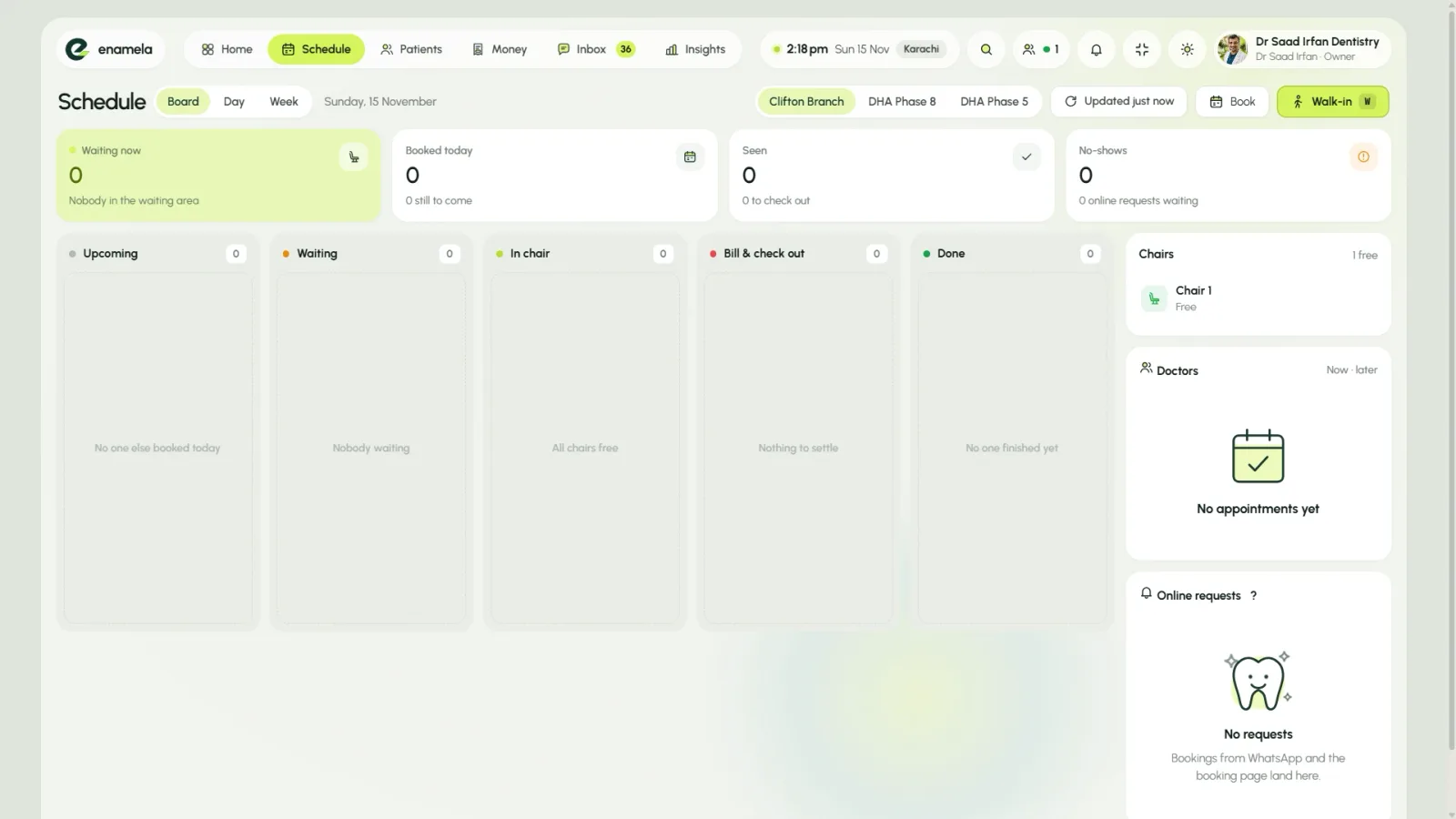
What matters most for a multi-branch practice is that there is one patient record. A patient registered at Phase 8 is the same patient at Clifton, with the same chart, the same allergy flag and the same balance. That alone fixed the problem above.
Online booking, walk-in tokens and a waiting room screen
This is where our patients noticed the change first.
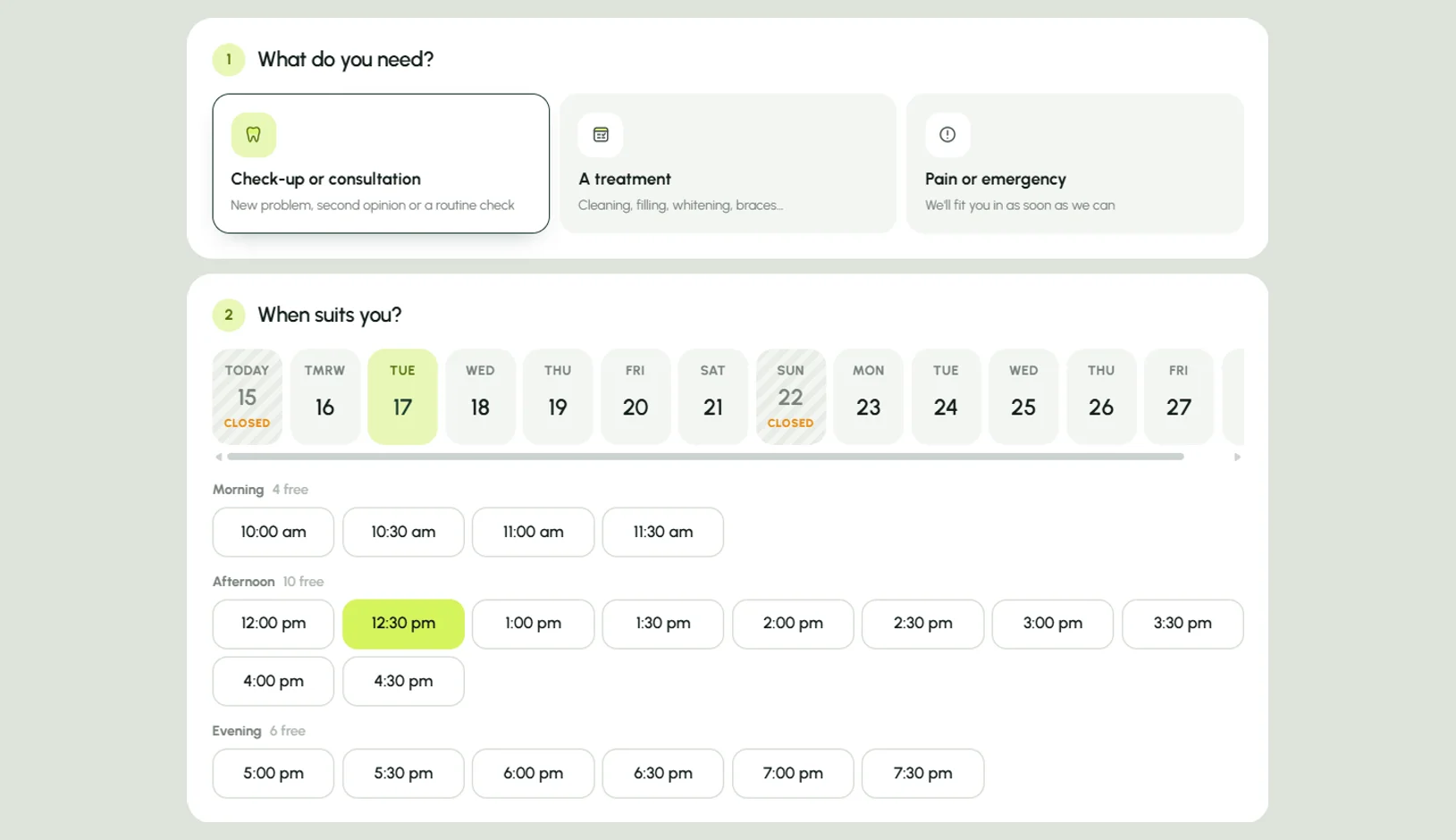
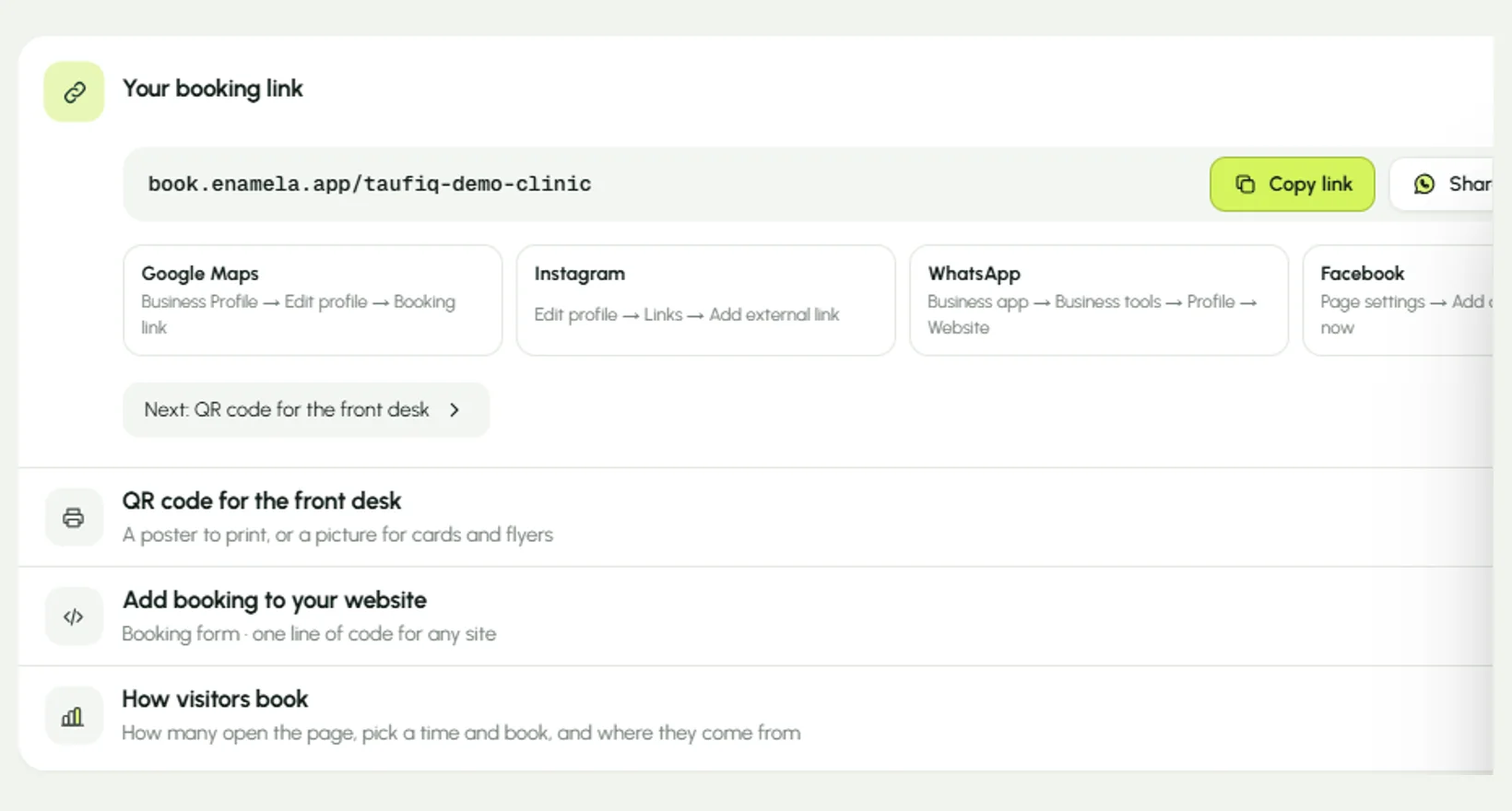
Online booking. The "Book online" button on this website opens Enamela's booking page. The patient chooses a branch, the reason for the visit (a check-up, a treatment, or pain and emergency), a time, and leaves a name and WhatsApp number. Nothing is charged online; reception confirms each request personally. The same link can sit on a Google Business Profile, Instagram and Facebook, and there is a printable QR poster for the front desk.
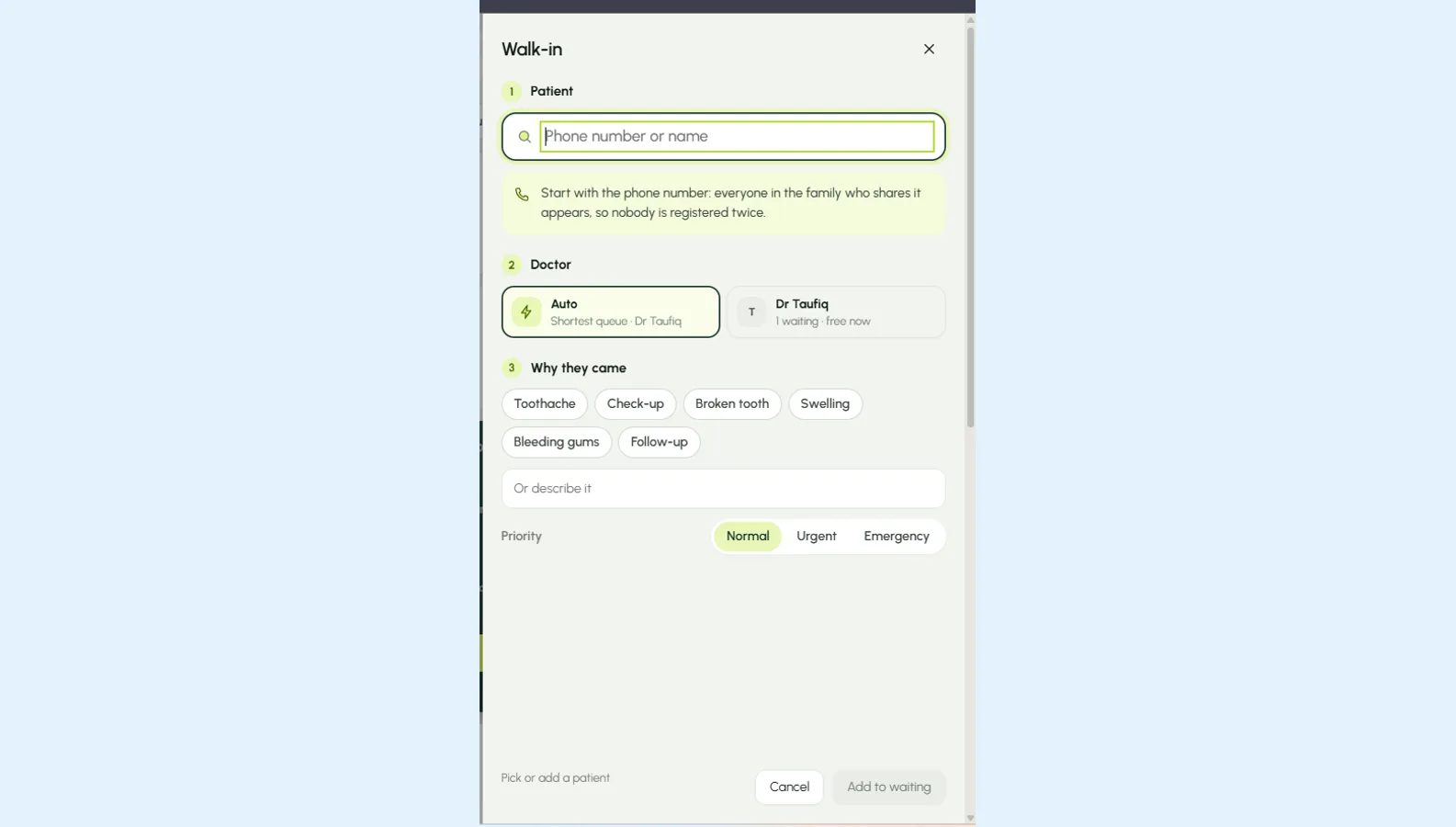
Walk-ins get a numbered token. Reception searches by phone number first, which brings up everyone in the family who shares that number, so a child is not registered twice under a parent's phone. The token slip shows the number, the doctor, and a QR code the patient can scan to follow the queue on their own phone.
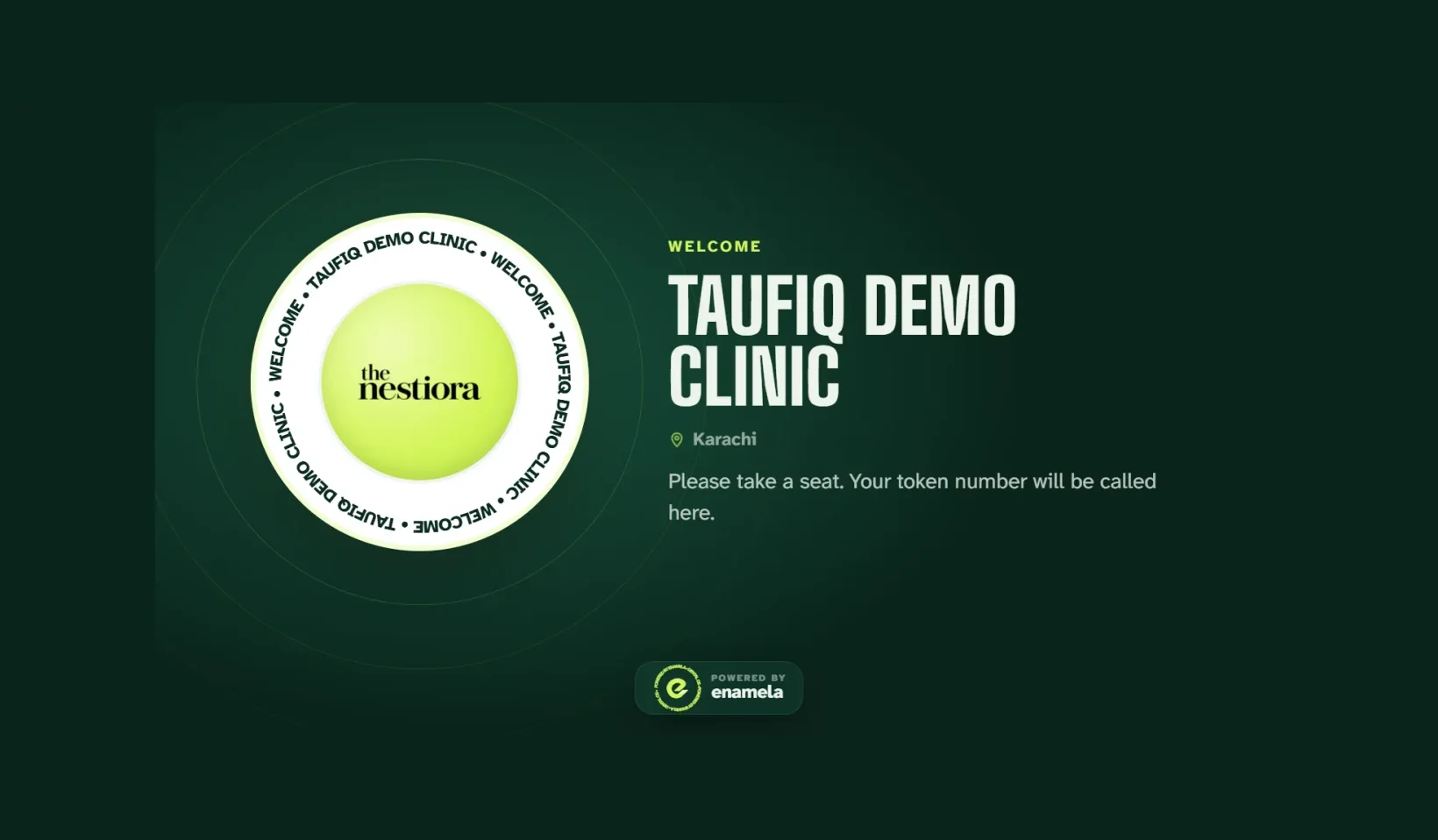
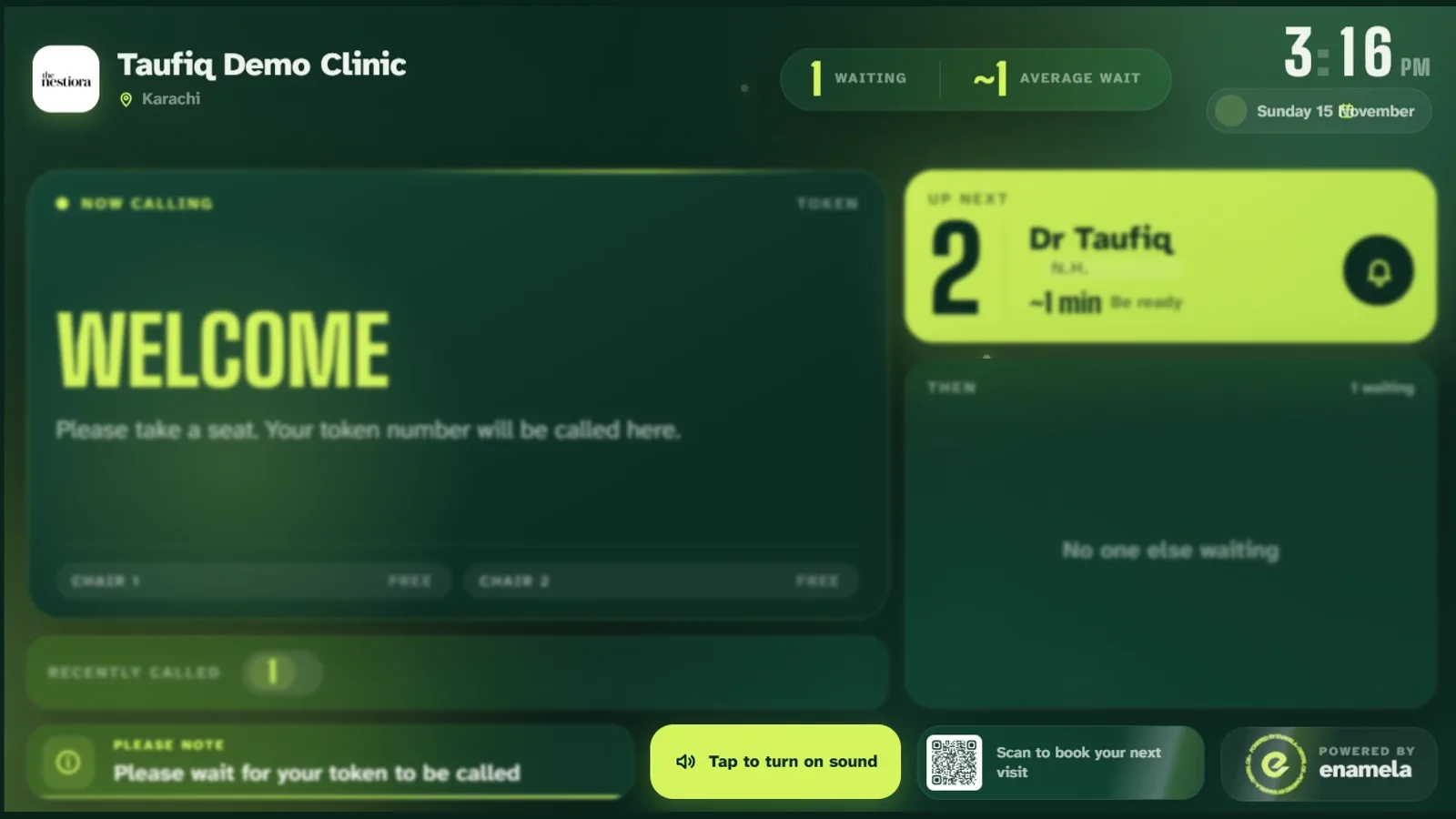
The waiting room screen runs on any TV with a browser. It shows who is being called, who is next and the average wait, plays a chime and can read tokens aloud. Patient names are never shown, only token numbers or initials, which matters in a waiting room full of neighbours. There is a lite mode for inexpensive TV boxes.
The tooth chart, from a restorative dentist's chair
My training is in restorative dentistry and dental materials, so this is the part I judged hardest.
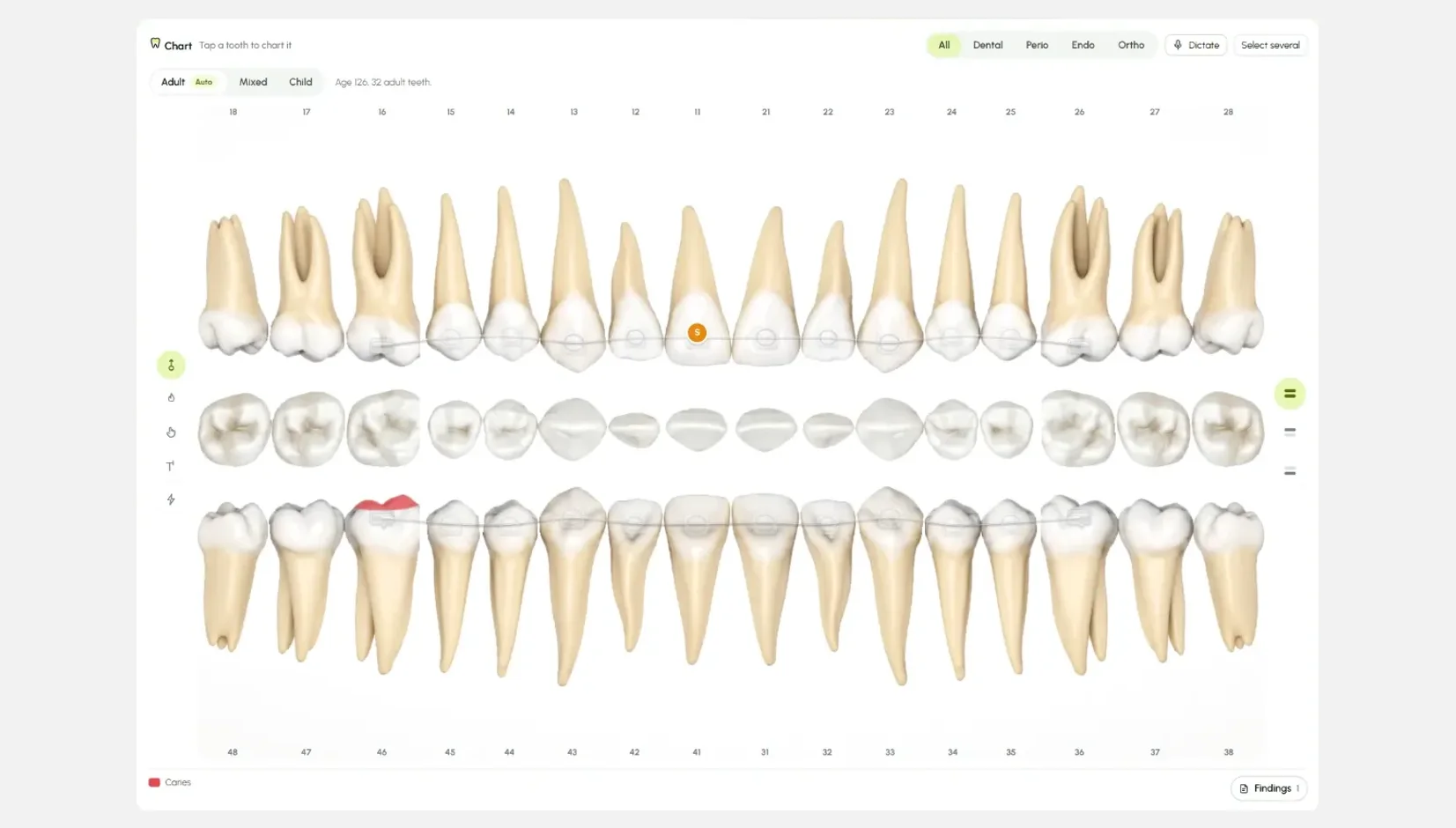
Enamela's dental charting uses FDI numbering with three-dimensional teeth, and switches between adult, mixed and child dentition by age. Primary teeth are charted as 51 to 85, which is correct and which a surprising amount of software gets lazy about.
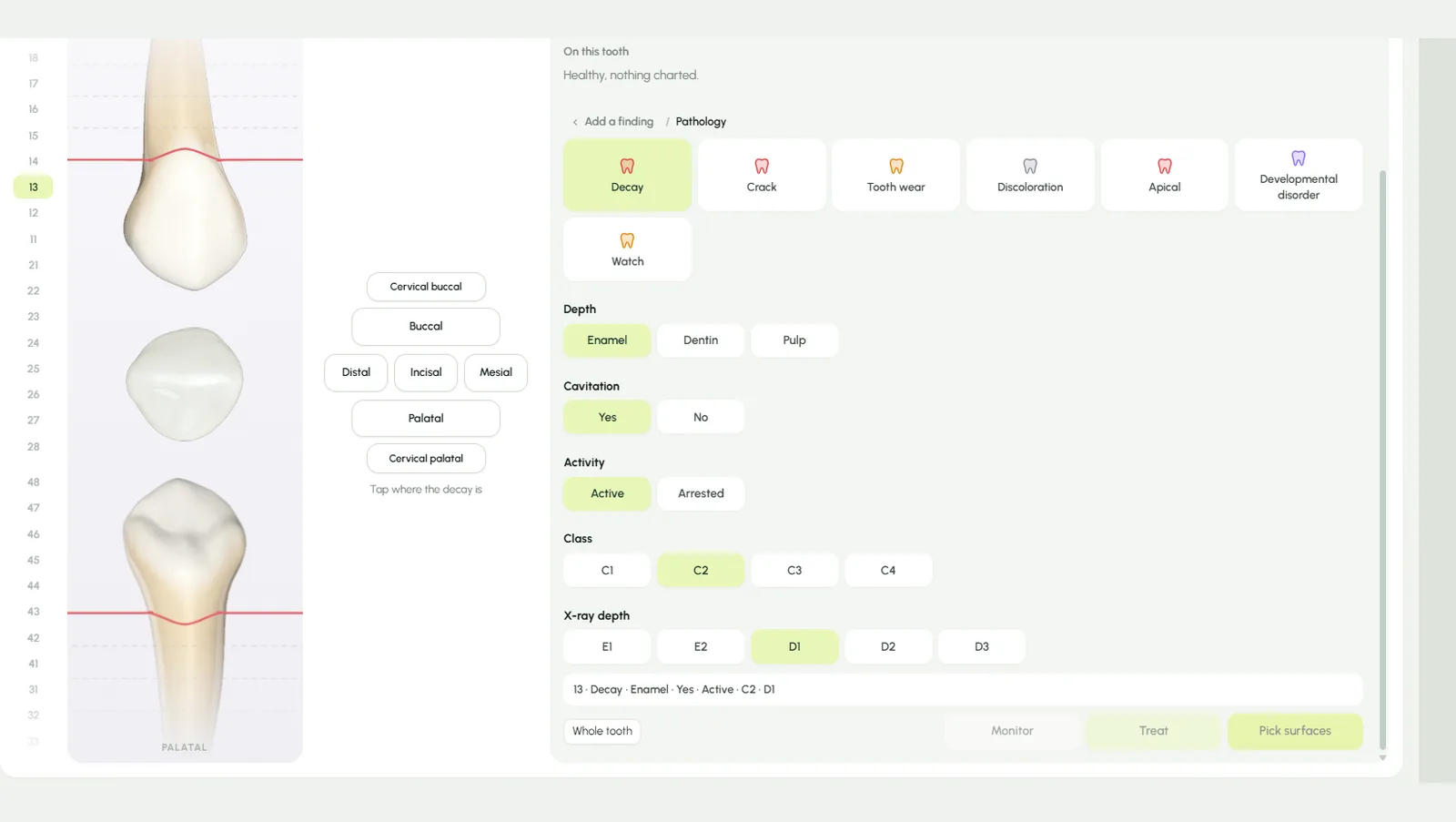
Recording caries is where it earns its place. Tap a tooth and it opens on its own, with every surface you can mark: cervical, buccal, mesial, distal, incisal or occlusal, and palatal.
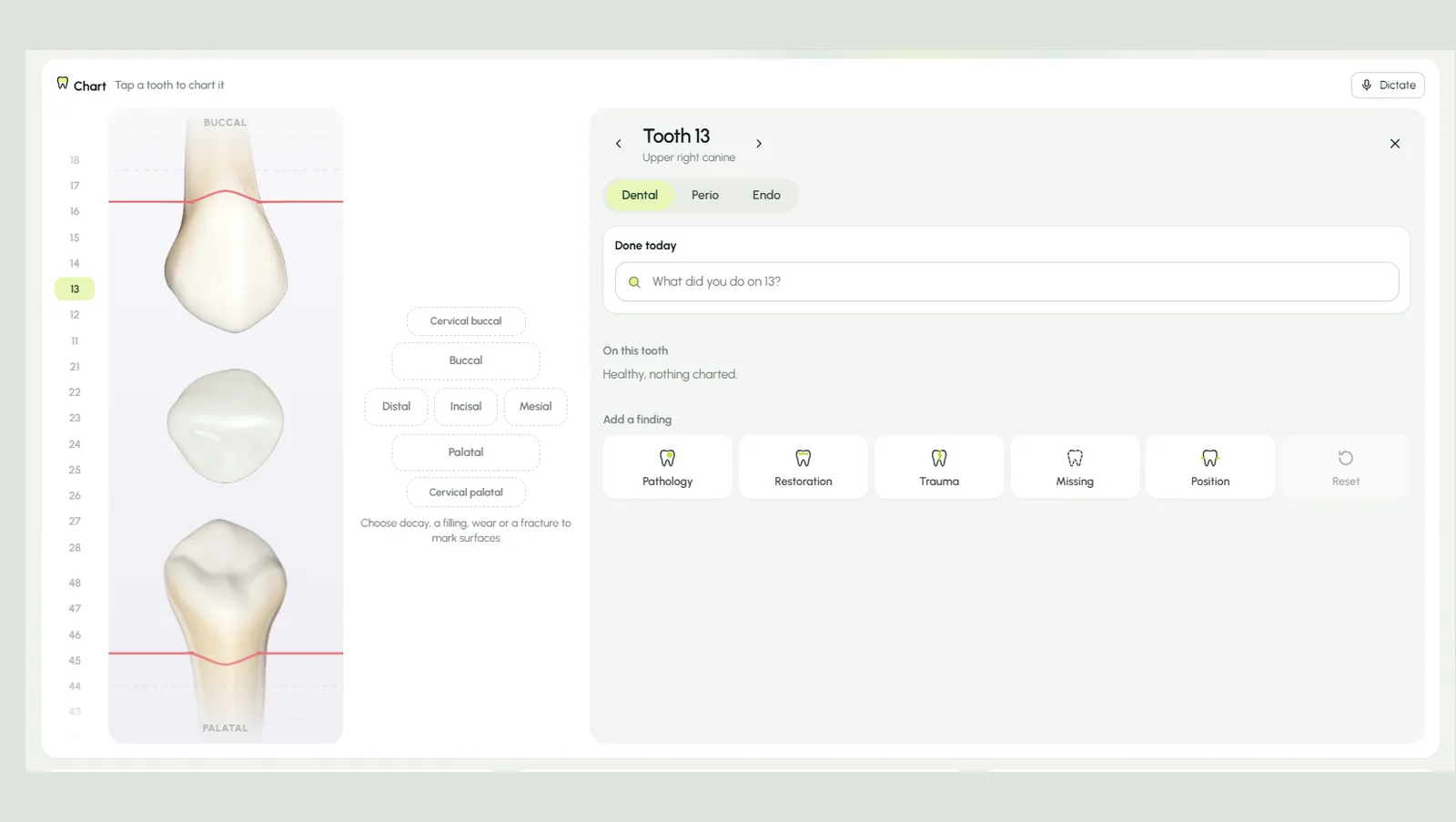
Choose Decay, and it asks for:
- Depth: enamel, dentin or pulp
- Cavitation: yes or no
- Activity: active or arrested
- Class: C1 to C4
- Radiographic depth: E1, E2, D1, D2 or D3
Then you choose Monitor or Treat, or mark the surfaces. That is the difference between "caries 46" and a finding a colleague can act on six months later without re-examining the patient.
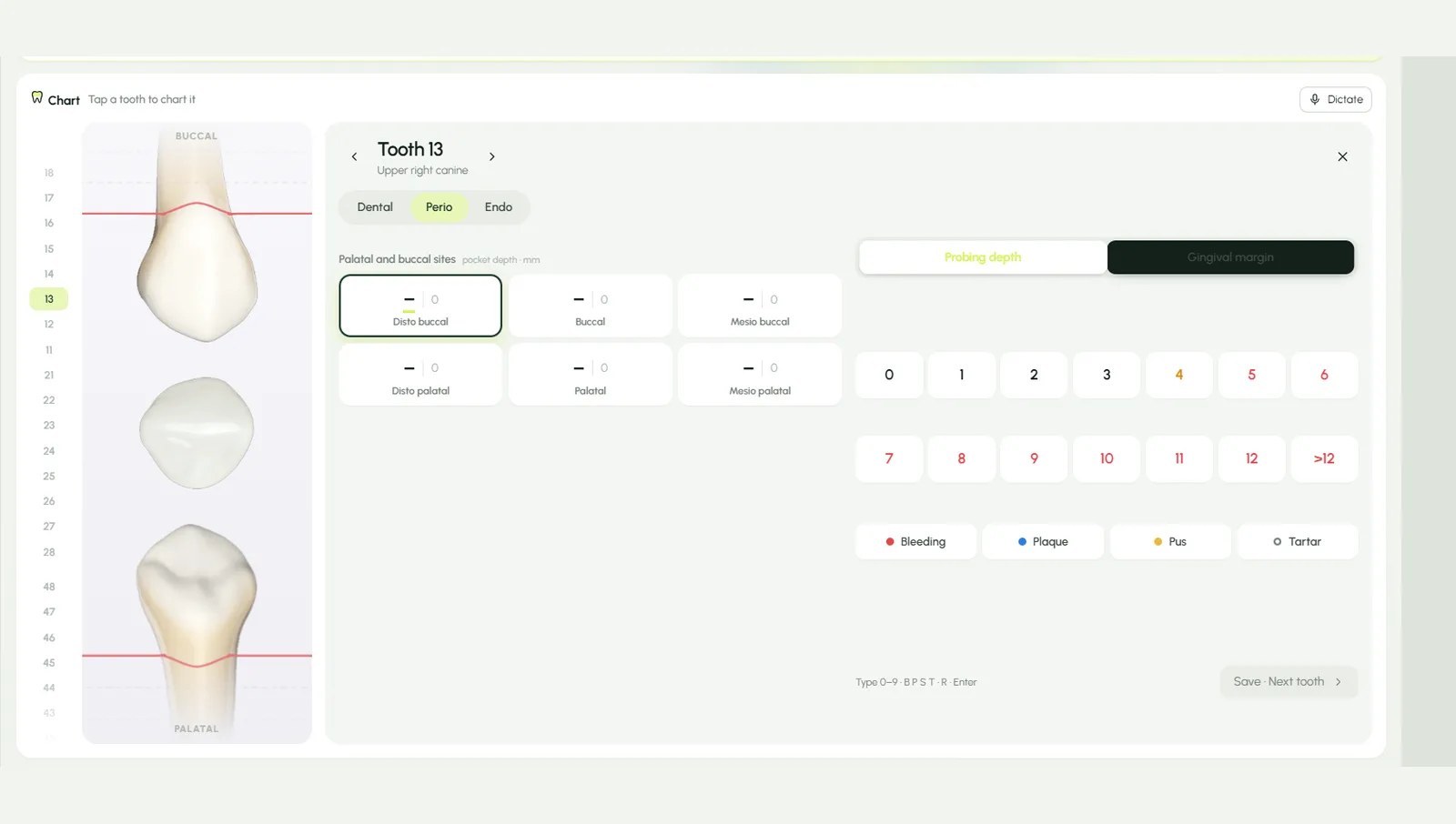
The perio tab records six sites per tooth on a number pad for probing depth and gingival margin, with bleeding, plaque, pus and tartar marked alongside. A full mouth can be entered from the keyboard without touching the mouse.
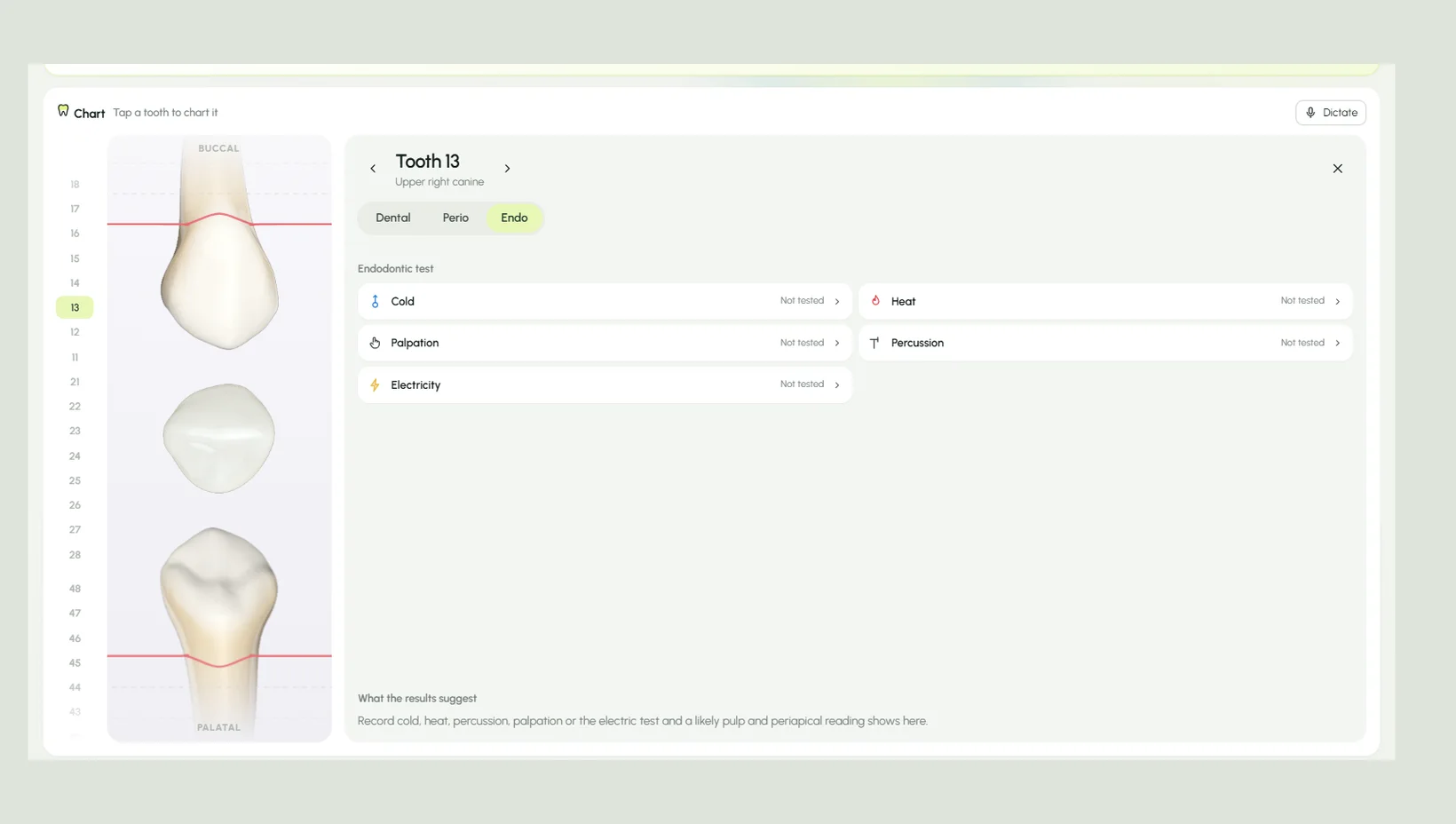
The endo tab records cold, heat, palpation, percussion and the electric pulp test, then shows a likely pulp and periapical reading. Enamela labels that reading as a guide, and it should be one: the diagnosis stays with the treating dentist.
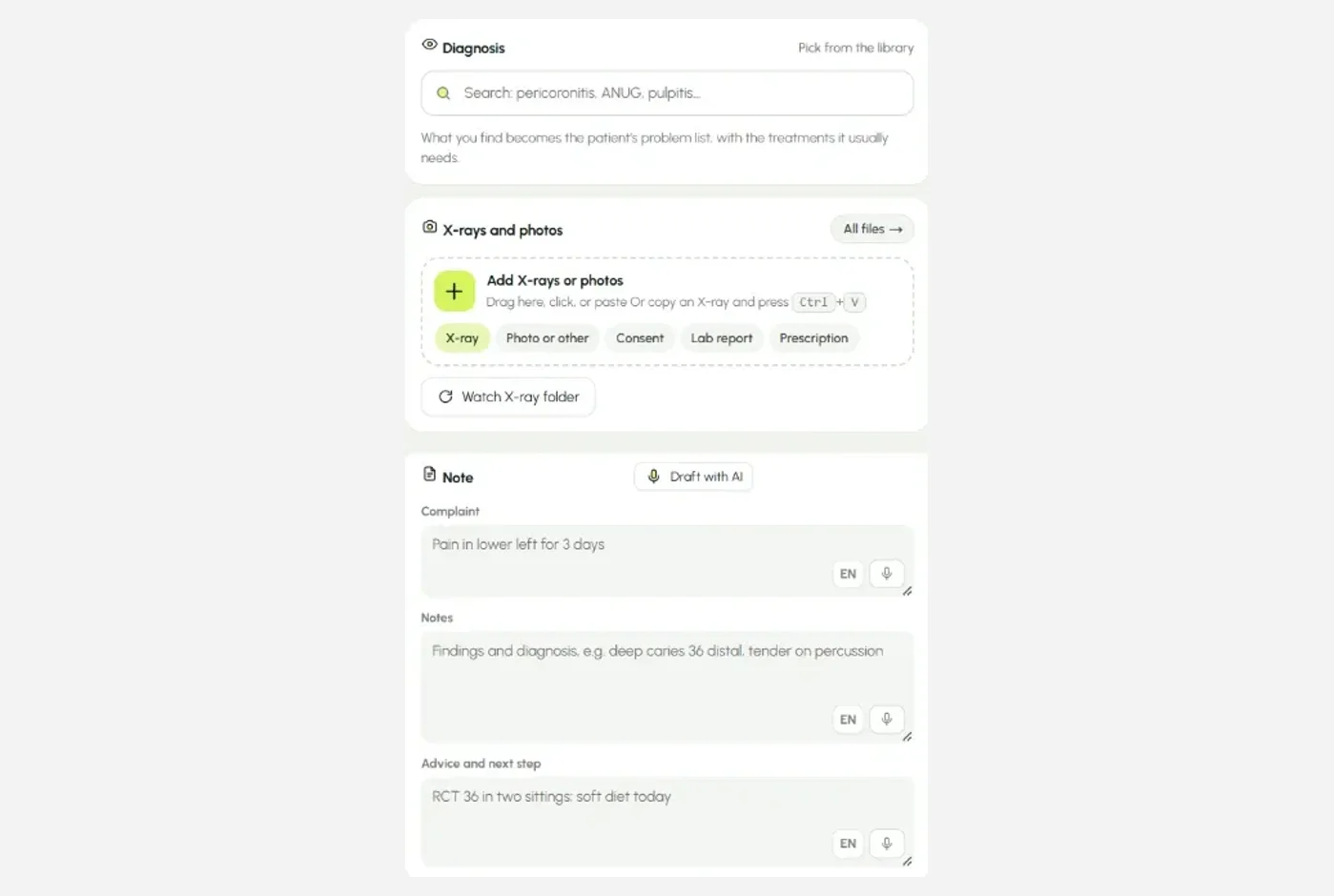
There is also a Dictate button, so findings can be spoken while gloved, and the visit note has a diagnosis library and an AI draft that the dentist edits before saving.
Braces and aligners tracked as a course
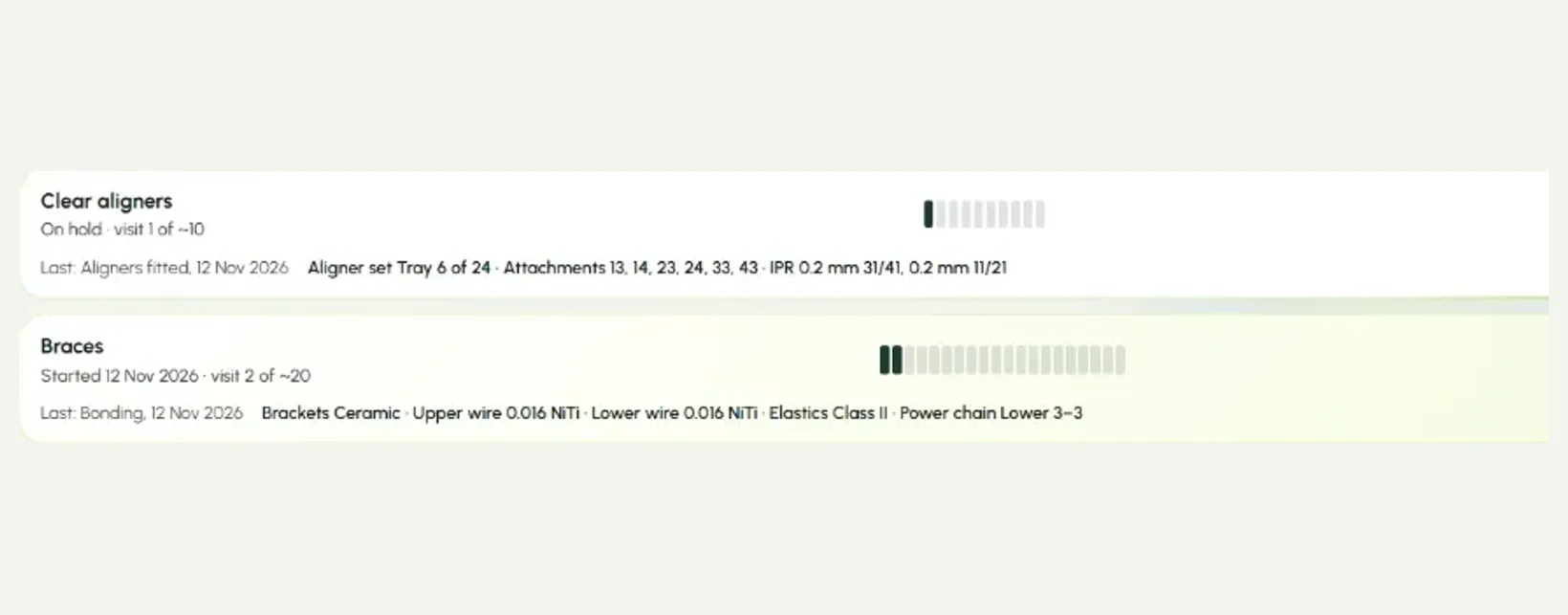
Orthodontics is a large part of our work across all three branches. In Enamela a braces case is opened as a course rather than a string of unrelated visits. Each adjustment logs the bracket type, the upper and lower wires, elastics and power chain, so the next appointment starts from what was actually placed. Aligner cases record the tray number, the attachments by tooth and any interproximal reduction. Both show the balance for the whole course on the visit screen, which ends the "how much is left?" conversation at reception.
Money that used to leak
The biggest surprise was not what Enamela added. It was what it showed us we were losing.
The home dashboard has a card called Needs attention. It lists visits where treatment was done and no bill was made. On paper those visits simply disappear, because nobody notices a bill that was never written. The follow-up queue ranks them alongside recalls, most worth chasing first, with buttons to call, open WhatsApp or make the bill.
- A bill can be paid in parts, by cash, card, bank transfer, JazzCash or Easypaisa, and each patient has a running statement
- Money owed is grouped by age: 0 to 30 days, 31 to 60, 61 to 90, and over 90
- Close the day counts the cash at each branch against what the system says was taken
- Visiting doctors can be paid a share of each bill after lab cost, and their statements show only their own work
Ena, the AI assistant, and plans in Urdu
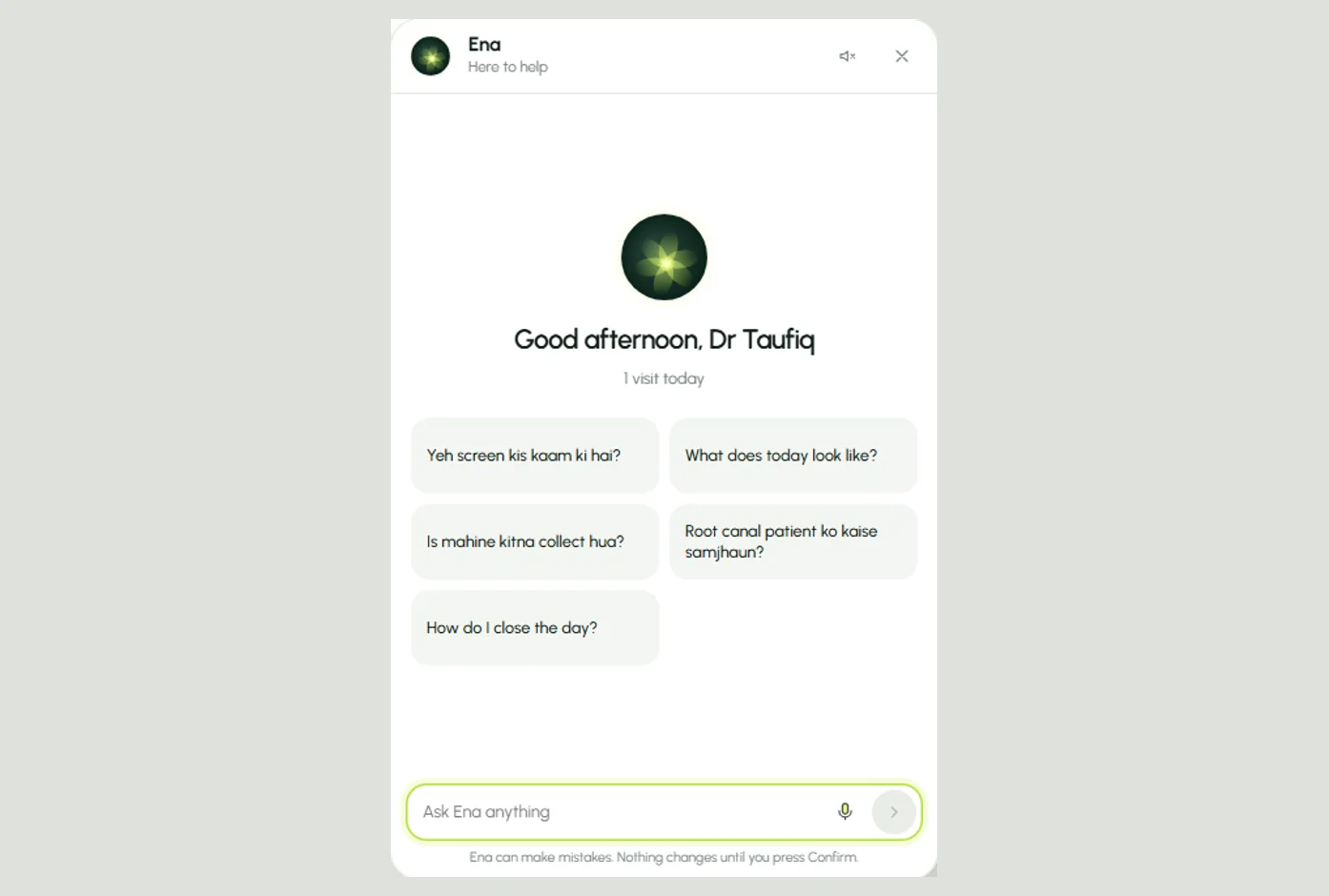
Enamela now has a built-in AI assistant called Ena. Staff can ask it plain questions in English or Roman Urdu, such as "is mahine kitna collect hua?", and it answers from the clinic's own records. It changes nothing until someone presses Confirm, and the screen says it can make mistakes, which is the right way round.
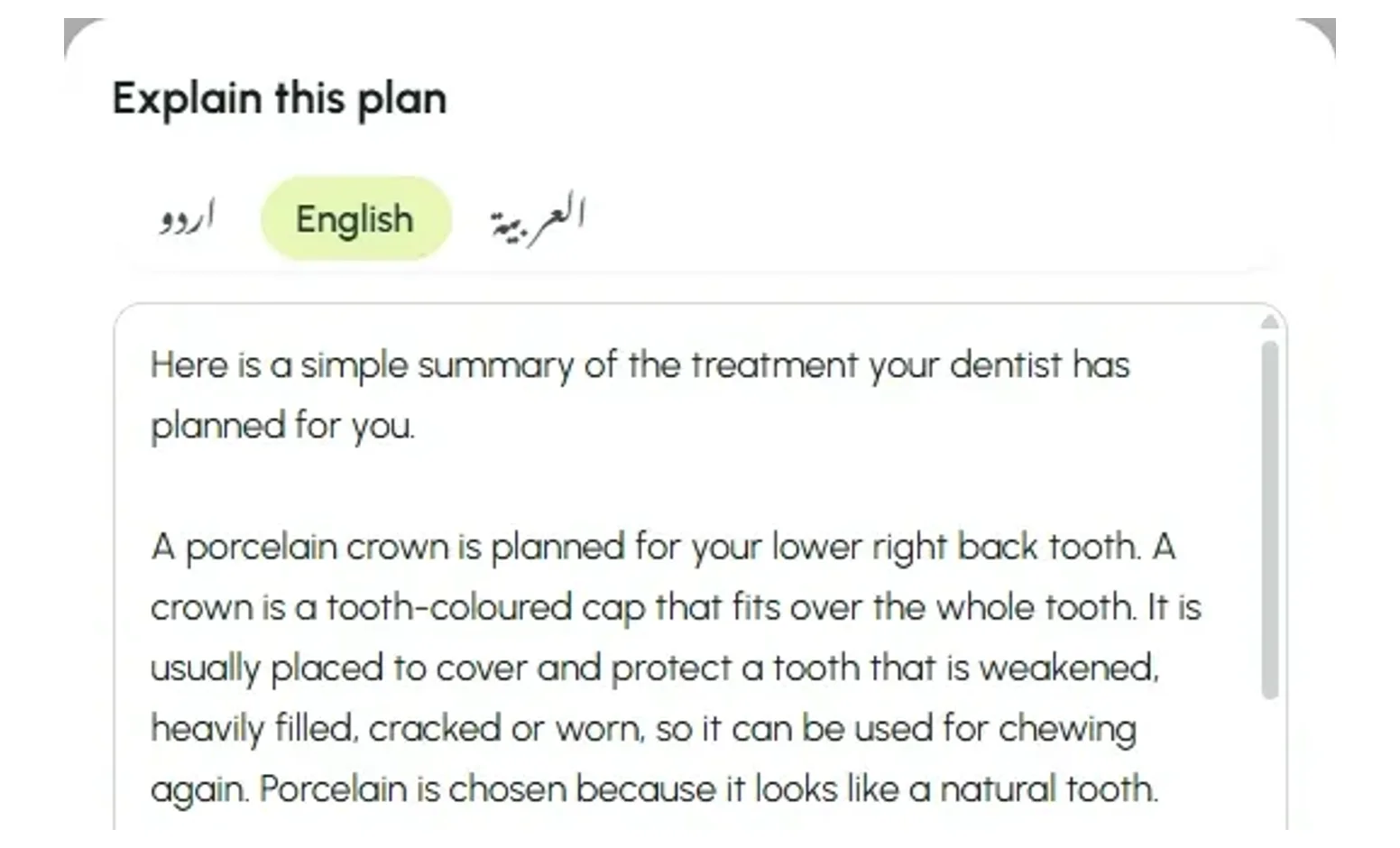
The same AI drafts a plain-language explanation of a treatment plan in Urdu, English or Arabic. I read and edit it before it goes to the patient on WhatsApp. I would not send a clinical explanation to a patient without reading it first, and nor should anyone else.
Prescriptions, documents and who can see what
Prescriptions print in English, Urdu or both, with morning, afternoon and night marked as dots rather than words, which helps patients who read neither language comfortably. Every prescription, bill and chart report carries a QR code that checks the document against the clinic's records, so a forged prescription with our name on it would fail that check.
Every action sits in an activity log: who registered a patient, who changed a bill, who opened a document, and when. Staff sign in with their own accounts and see only the branches and screens their role allows. Enamela's own support staff can see patient data only if we grant access, read-only and for a limited time, and that access is logged as well.
What is not there yet
Six weeks is enough to see the gaps.
- WhatsApp from our own number is not live yet. Enamela is building automatic reminders, receipts and plans sent from the clinic's WhatsApp Business number. Until that lands, messages go out through WhatsApp buttons rather than automatically.
- Treatment margins need setting up. The Insights page can show profit per treatment, but only after you enter the materials each treatment uses. Until then every treatment shows a 100% margin, which is not a number to make decisions on.
- It runs in the browser. Enamela does not advertise an offline mode, so a clinic with unreliable internet should plan for that.
Who Enamela suits
It suits a practice with more than one chair, more than one dentist or more than one branch, where the hard part is coordination rather than dentistry. It especially suits clinics that take JazzCash and Easypaisa, write prescriptions in Urdu, or run orthodontic cases over many months. It matters less to a single dentist with one chair and a short patient list who already keeps careful paper records.
Enamela publishes its prices. As of November 2026 they are PKR 4,000 a month for Starter (one branch), PKR 9,500 for Pro (one branch, with treatment plans) and PKR 25,000 for Chain (up to five branches), which is the plan a three-branch practice like ours needs. There is a 14-day free trial with no card required.
Current plans and the free trial are on Enamela's own site.
Source: Enamela pricing
Summary of This Article
Dr Saad Irfan, lead dentist at Dr Saad Irfan & Associates Dentistry in Karachi, reviews Enamela, a browser-based dental clinic software, after moving all three branches (DHA Phase 5, DHA Phase 8, Clifton Block 9) from paper to Enamela on 1 October 2026. The review covers the shared multi-branch schedule and patient record, online booking, walk-in tokens and a waiting room screen, FDI tooth charting with caries depth and activity, six-site periodontal charting and pulp testing, orthodontic course tracking, part payments by JazzCash and Easypaisa, Urdu prescriptions with QR verification, the activity log, and the Ena AI assistant. Automatic WhatsApp reminders from the clinic's own number were not yet live at the time of writing. The clinic was Enamela's first trial clinic and now pays for it.
Frequently Asked Questions
Ready to Transform Your Smile?
Book your professional assessment (2,000 PKR) with Dr. Saad Irfan. Open 7 days a week, 9AM-11PM at DHA Phase 5, DHA Phase 8, and Clifton Block 9 clinics in Karachi.
🔥 Popular Reads

Medical Disclaimer: This content is for informational purposes only and does not constitute medical advice. Always consult a qualified dentist for diagnosis and treatment specific to your condition. Results may vary depending on individual cases. Dr. Saad Irfan Dentistry, Karachi.
About the Author
Dr. Saad Irfan
Senior Dental Surgeon, MDS Restorative Dentistry (Sheffield, UK). Dr. Saad has over 15 years of clinical experience in restorative and cosmetic dentistry. He trained at the University of Sheffield, UK, and practices at DHA Phase 5, DHA Phase 8, and Clifton Block 9 clinics in Karachi. He is committed to pain-free, evidence-based dental care.