
Implants vs Dentures: Which is Better? Cost & Comparison
Medically reviewed byDr. Saad IrfanMDS, MSc, BDS·
Key Takeaways
- 1Dental implants are permanent titanium posts that fuse with jawbone, they last 20+ years or a lifetime
- 2Dentures are removable prosthetic teeth, more affordable but require daily maintenance
- 3Implants preserve jawbone and prevent facial collapse; dentures don't
- 4Implant cost in Karachi quoted after examination; dentures are more affordable
- 5Implant-supported dentures offer a hybrid option combining stability with lower cost
Whether you've just lost a tooth or you've been living with gaps in your smile for years, you're probably weighing two major solutions: dental implants or dentures. Both restore function and appearance, but they work very differently and suit different lifestyles and health profiles. This comprehensive guide will help you make a confident, informed decision about which option is best for your situation.
The Fundamental Difference
Dental implants are surgically placed titanium posts that fuse with your jawbone, acting as artificial tooth roots. A crown is then attached on top, creating a permanent, fixed tooth that functions identically to a natural one. Dentures, on the other hand, are removable prosthetic teeth that rest on the gums, either for a full arch (complete dentures) or partial replacement (partial dentures). The fundamental difference is permanence: implants become part of your body, while dentures come in and out.
This distinction has far-reaching implications for your daily life, your oral health, and your long-term costs. Implants require surgery and a healing period, but once placed, they require no special maintenance beyond normal brushing and flossing. Dentures require no surgery but demand daily removal, cleaning, and the use of adhesives to stay in place.
Dental Implants: The Modern Gold Standard
Dental implants were first successfully placed in 1965 by Swedish orthopedic surgeon Per-Ingvar Brånemark, who discovered that titanium naturally fuses with bone tissue, a process he called 'osseointegration.' Since then, implant technology has advanced dramatically, and implants are now considered the gold standard for tooth replacement worldwide.
When you lose a tooth, the jawbone beneath it begins to deteriorate because it no longer receives stimulation from chewing. Within the first year after tooth loss, you can lose up to 25% of the surrounding bone volume. This bone loss continues over time, eventually changing the shape of your face and making you appear older. Implants solve this problem by replicating the stimulation of a natural tooth root, preserving your bone structure and facial shape.
- Permanent solution, can last a lifetime with proper care
- Feels and functions exactly like a natural tooth
- Preserves jawbone and prevents facial collapse
- No dietary restrictions, eat anything you want
- No adhesives, removable parts, or nightly removal
- Higher upfront cost but often more economical long-term
- Success rate of 95-98% with modern implant systems
- Does not affect adjacent healthy teeth
Dentures: The Accessible Alternative
Dentures have come a long way from the ill-fitting, click-prone devices of previous generations. Modern dentures are crafted from advanced acrylic and metal materials that look remarkably natural and fit comfortably. They remain the best option for patients who aren't candidates for surgery or who need to replace an entire arch of teeth at a lower cost.
- Lower upfront cost, more accessible to more patients
- Non-surgical solution, ideal for those with health conditions that prevent surgery
- Can replace many teeth or full arches at once
- Modern materials look very natural
- Require daily removal and cleaning
- May need to be relined or replaced every 5–8 years
- Can slip or click while eating or speaking (especially lower dentures)
- Do not prevent jawbone loss
A Hybrid Option Exists
Implant-supported dentures combine both worlds, 2-4 strategically placed implants anchor a removable denture arch, giving you stability without the cost of full implants for every tooth. This option eliminates slipping while keeping costs lower than individual implants.
Cost Comparison: The Real Numbers
Cost is often the deciding factor, so let's look at the real numbers, both upfront and long-term. In Karachi, dental implants start from Rs 125,000 per tooth including the implant post, abutment, and premium zirconia crown. A full mouth implant restoration (all-on-4 or all-on-6) can varies with the case.
Complete dentures generally cost a figure we confirm after assessment. However, when calculating true long-term cost, implants often prove more economical. Dentures need replacement every 5-8 years (costing up to Rs 80,000 each time), require adhesives and cleaning solutions (up to Rs 5,000 annually), and may cause bone loss that requires additional treatment. Over 20 years, a single dental implant at a price confirmed after examination may cost less than repeatedly replacing a denture.
Who Is a Good Candidate for Each?
Implants require sufficient jawbone density to anchor the post, good overall health for surgery, and non-smoking status (or willingness to quit temporarily, as smoking significantly affects healing). Patients on blood thinners or with uncontrolled diabetes need careful evaluation. Age is not a barrier, implants have been successfully placed in patients in their 80s.
Dentures are suitable for patients with significant bone loss (where implants may need bone grafting first), multiple systemic health conditions that make surgery risky, those who prefer a non-surgical approach, or patients who need to replace many teeth simultaneously and cannot afford individual implants.
The American Dental Association provides comprehensive guidance on tooth replacement options.
Source: American Dental Association
Making Your Decision
The right choice depends on your health profile, lifestyle, budget, and long-term goals. We recommend a thorough consultation with an experienced oral surgeon who can evaluate your bone structure via 3D imaging and discuss which option will genuinely serve you best for the decades ahead. At our Karachi clinics, we offer professional assessments (2,000 PKR) where Dr. Saad will assess your specific situation and recommend the most appropriate treatment.
“The goal isn't just to fill a gap, it's to restore your confidence, your function, and your quality of life. Both implants and dentures can do that beautifully when matched to the right patient.”
Summary of This Article
Dental implants and dentures are the two main options for replacing missing teeth. Implants are permanent titanium posts surgically placed in the jawbone that last 20+ years, preserve bone structure, and is quoted per tooth after examination in Karachi. Dentures are removable, more affordable, but require daily cleaning and replacement every 5-8 years. Implant-supported dentures offer a hybrid solution. Dr. Saad Irfan at DHA Karachi offers both options with professional assessments (2,000 PKR) to determine the best choice.
Frequently Asked Questions
Ready to Transform Your Smile?
Book your professional assessment (2,000 PKR) with Dr. Saad Irfan. Open 7 days a week, 9AM-11PM at DHA Phase 5, DHA Phase 8, and Clifton Block 9 clinics in Karachi.
🔥 Popular Reads
Medical Disclaimer: This content is for informational purposes only and does not constitute medical advice. Always consult a qualified dentist for diagnosis and treatment specific to your condition. Results may vary depending on individual cases. Dr. Saad Irfan Dentistry, Karachi.
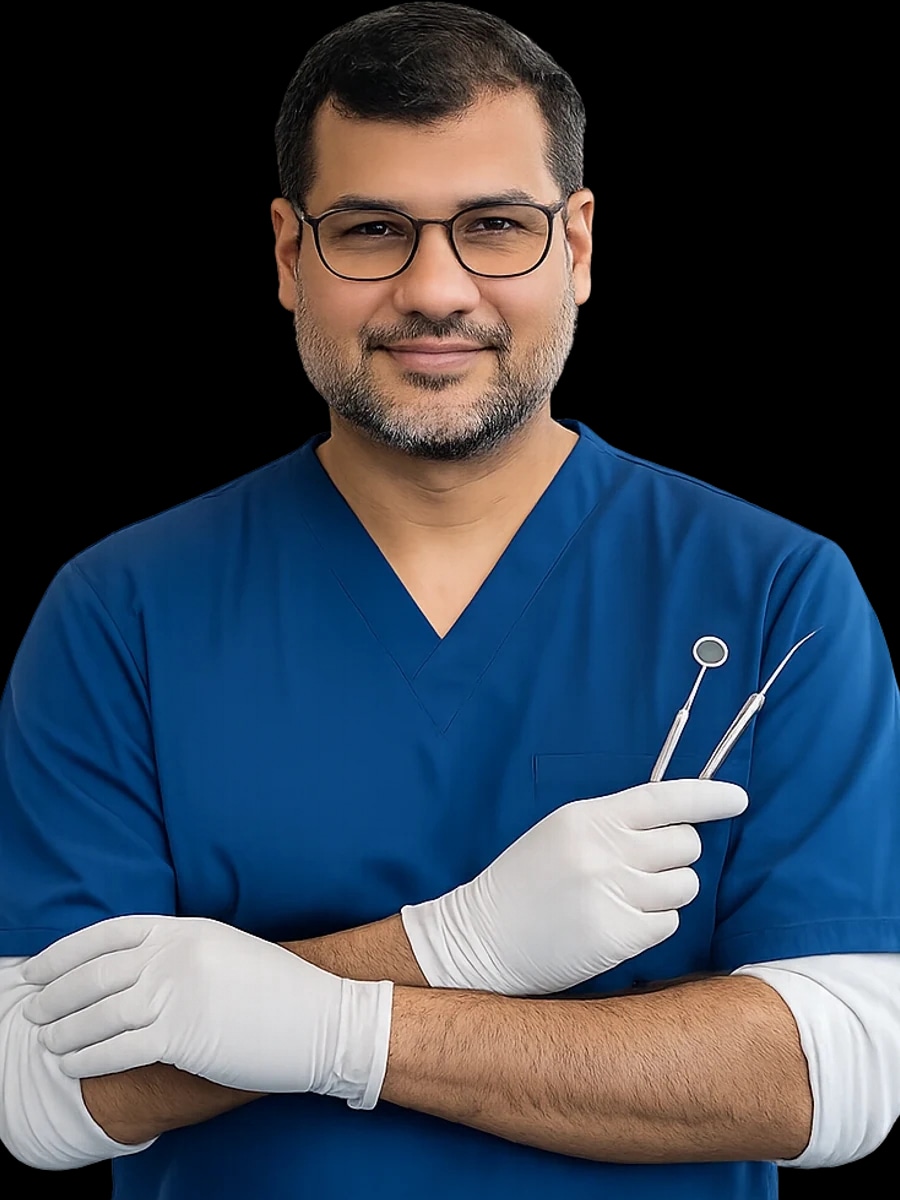
About the Author
Dr. Saad Irfan
Senior Dental Surgeon, MDS Restorative Dentistry (Sheffield, UK). Dr. Saad has over 15 years of clinical experience in restorative and cosmetic dentistry. He trained at the University of Sheffield, UK, and practices at DHA Phase 5, DHA Phase 8, and Clifton Block 9 clinics in Karachi. He is committed to pain-free, evidence-based dental care.