
Orthodontic Treatment (Braces)
If you are reading this page, you have probably already looked in the mirror more than once and thought about your teeth. Maybe it is a gap that has bothered you since school. Maybe it is crowding that has gotten worse with age. Maybe your dentist mentioned your bite is putting extra wear on certain teeth. And along with the thought of fixing it comes a string of quieter questions most people never say out loud: will it hurt, will I look strange with metal in my mouth for two years, can I actually afford this, and will it even work for teeth like mine? These are fair questions, and they deserve honest answers, not just a list of services. Dr. Saad Irfan holds an MDS in Restorative Dentistry and an MSc in Dental Materials from the University of Sheffield, UK, is PMDC registered, and has over 15 years of clinical experience. Every orthodontic case begins with a full diagnostic workup, not a five-minute glance: digital X-rays, photographs, and a bite assessment, so the treatment plan is built on your actual mouth rather than a generic protocol. We treat orthodontic patients from age 7 through adulthood using traditional metal braces, ceramic braces, and Invisalign clear aligners at our DHA Phase 5, DHA Phase 8, and Clifton Block 9 clinics. All three are open 9AM to 11PM, 7 days a week, which matters for orthodontic patients specifically because you return every 4 to 6 weeks for years and evening or weekend appointments never have to interrupt school or work.
Medically reviewed byDr. Saad Irfan— MDS, MSc, BDS·
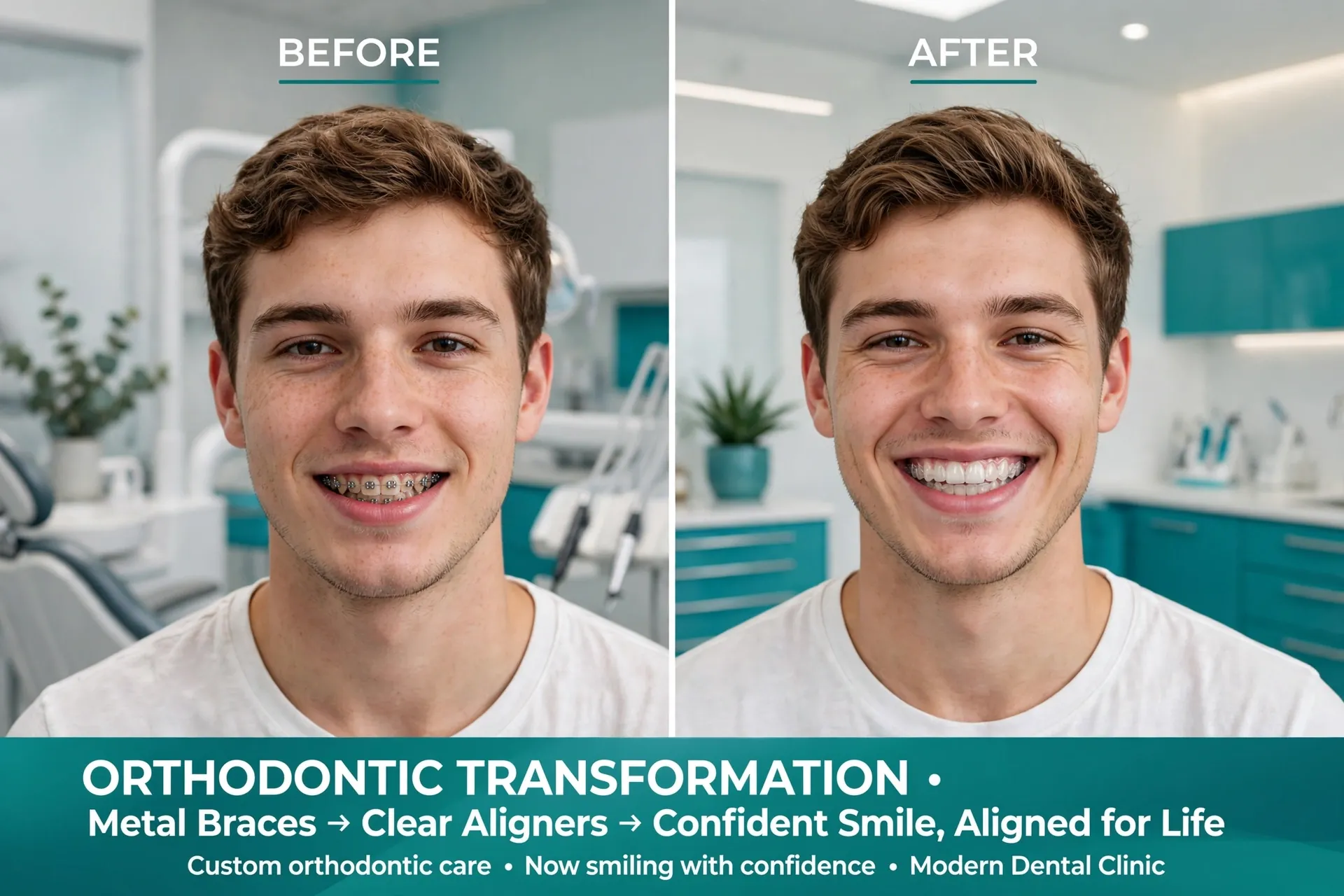
Priced
for a full course
Assessment
PKR 2,000
Open
9AM–11PM
Google rating
5.0★ (346)
What is Orthodontic Treatment (Braces)?
Orthodontics is the branch of dentistry that diagnoses, prevents, and corrects misaligned teeth and jaws. The medical term for misalignment is malocclusion. Braces do not force teeth into place the way a hand bends a wire. They work with a biological process your body already knows: each tooth sits in a socket lined with a ligament, around which is living bone. When gentle sustained pressure is applied through a wire or aligner, the bone on the pressure side slowly dissolves (resorption) while new bone forms on the opposite side (deposition). The tooth migrates through the bone millimetre by millimetre over weeks and months. This is the same biological remodelling that heals a fracture. It is also why retainers are non-negotiable afterward: the bone and ligament around a newly moved tooth take months to stabilise, and until they do the tooth wants to drift back. Straight teeth are healthier teeth, not just more attractive ones, because crowding makes plaque accumulate where a brush cannot reach.
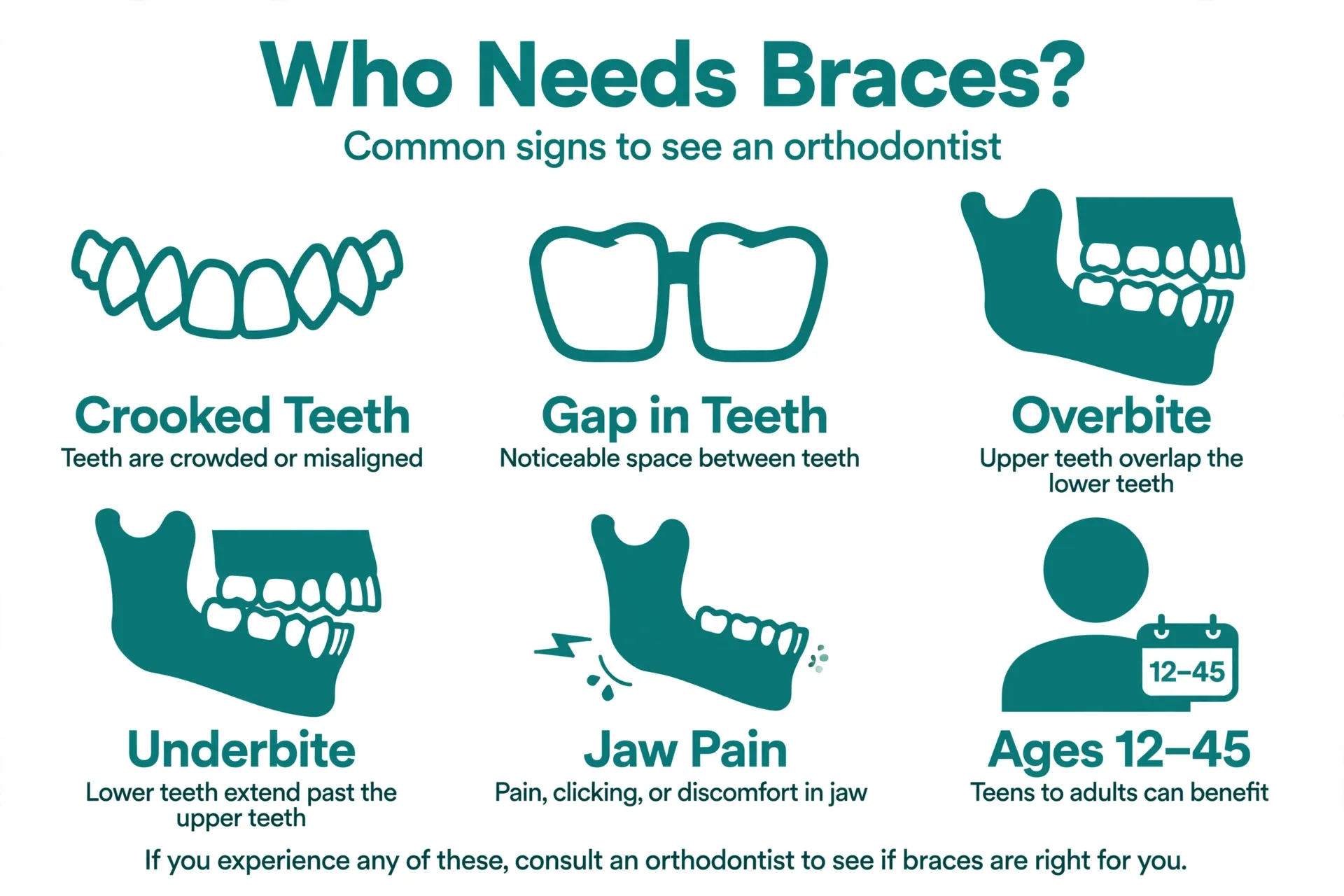
Is Orthodontic Treatment (Braces) Right for You?
If you experience any of the following, braces treatment may be recommended.
Clinically reviewed by Dr. Saad Irfan, BDS, MDS Restorative Dentistry & MSc Dental Materials (University of Sheffield, UK), PMDC Registered.
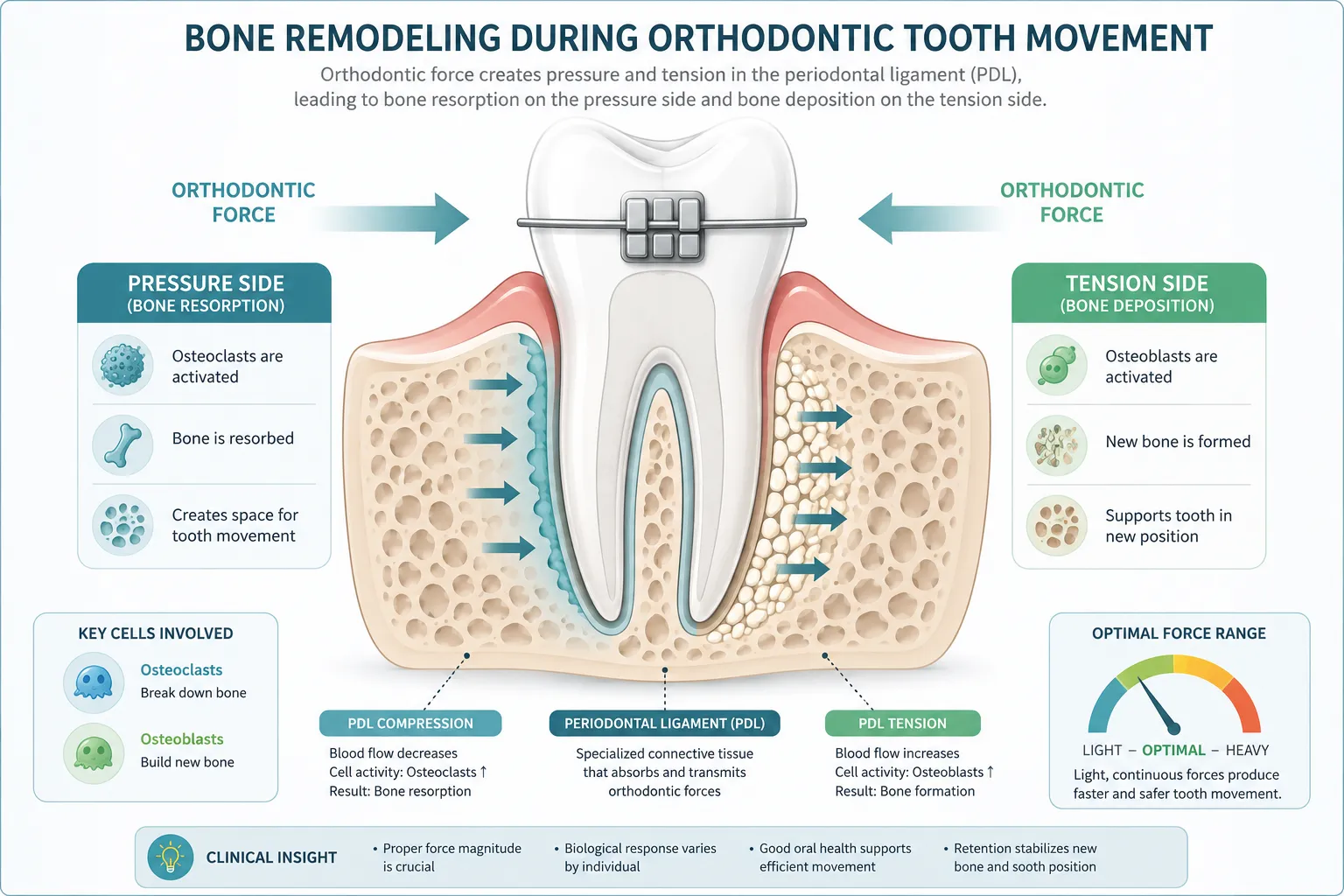
How Braces Actually Move Teeth — The Biology Behind It
Braces do not force teeth into place the way a hand bends a wire. They work with a biological process your body already knows how to do. Each tooth sits in a socket lined with a ligament, and around the socket is living bone. When gentle, sustained pressure is applied to a tooth through a wire or aligner, the bone on the pressure side slowly dissolves (a process called resorption), while new bone forms on the opposite side (deposition). The tooth physically migrates through the bone, millimetre by millimetre, over weeks and months. This is exactly the same biological remodelling process that heals a fracture.
This explains two things patients often ask about. First, why movement is slow — bone can only remodel at a certain biological speed, and pushing harder does not speed it up, it just causes more pain and root damage risk. Second, why retainers are non-negotiable afterward — the bone and ligament around a newly moved tooth takes months to fully stabilise, and until it does, the tooth wants to drift back. This is not a flaw in your treatment. It is simply how bone biology works, and it is exactly why every orthodontic case at our clinic ends with a proper retainer, not an optional add-on.
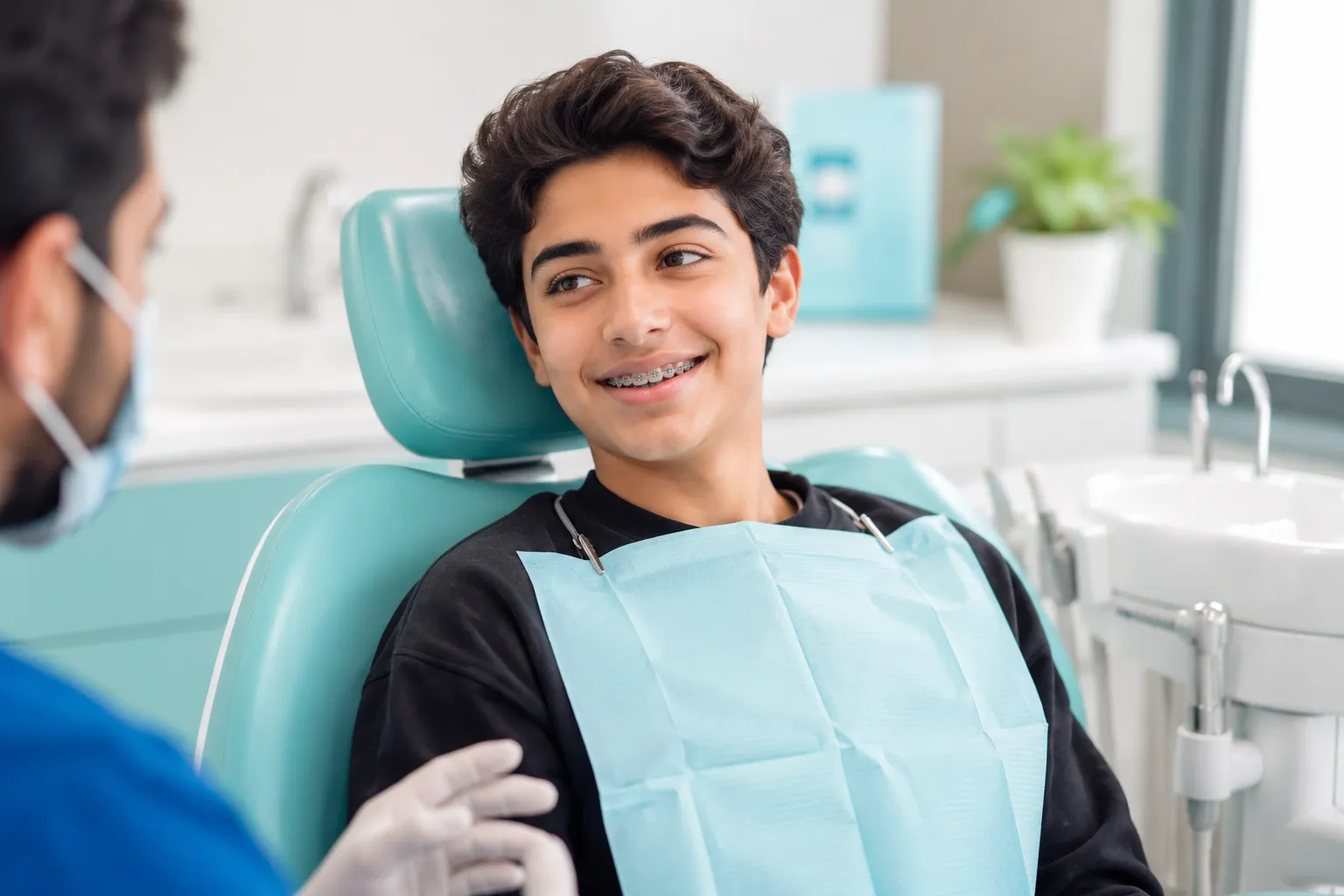
Do Braces Hurt? An Honest Answer, Not a Marketing One
Some clinics promise "completely painless" braces. That is not accurate, and we would rather tell you the truth than sell you a fantasy you will discover is false on day three. Fitting the braces or first aligner tray does not hurt — there is no injection, no drilling. Real discomfort begins 12 to 36 hours after fitting or after each adjustment, as the sustained pressure activates the bone remodelling process. Teeth feel tender and sore for chewing, roughly the feeling of a bruise, typically for 2 to 4 days after each adjustment. Ceramic and metal brackets can also irritate the inside of the cheeks and lips for the first 1 to 2 weeks until the tissue toughens and you learn to use orthodontic wax.
What actually helps: an over-the-counter anti-inflammatory painkiller, taken as directed on the packet about an hour before your adjustment appointment, blunts the peak soreness significantly. Cold foods and drinks in the first 48 hours reduce inflammation and are genuinely soothing. Orthodontic wax, provided at every visit, stops a rubbing bracket from cutting the cheek. Most patients describe the discomfort as very manageable after the first week, and by month two the process fades into the background of normal life. Invisalign causes a similar but generally milder ache with each new tray, typically lasting 1 to 2 days rather than 2 to 4.
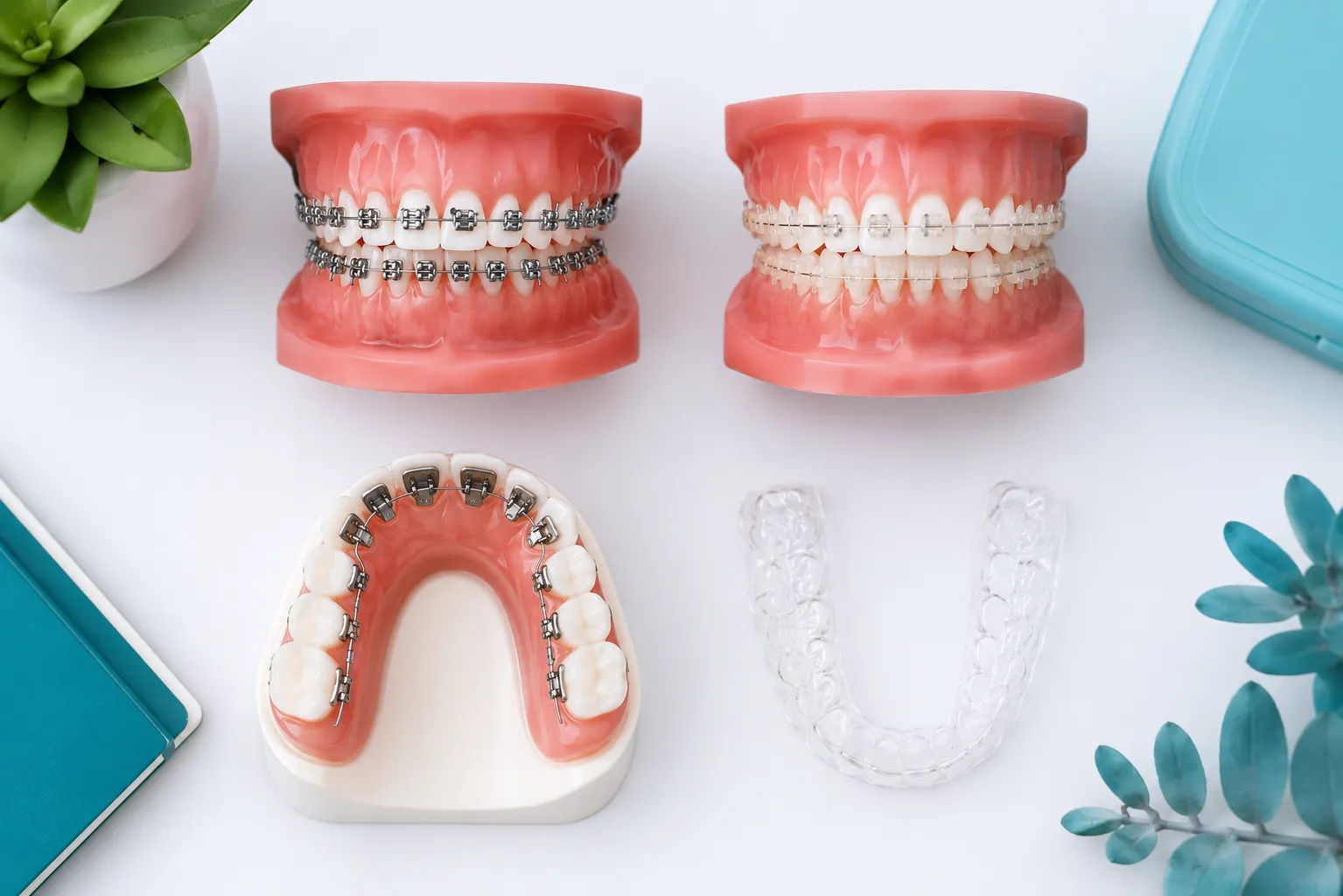
Metal, Ceramic, Lingual, or Invisalign — Which One Is Right for You?
There is no single "best" type of braces. There is a best type for your specific bite, budget, and lifestyle. Here is an honest comparison of all four options we offer.
| Type | Visibility | Best For | Typical Duration | Starting Price |
|---|---|---|---|---|
| Traditional Metal Braces | Most visible — silver brackets and wire | Complex bite corrections, all ages, best value for the correction achieved | 18 to 30 months | From Rs 120,000 |
| Ceramic Braces | Tooth-coloured brackets, much less noticeable than metal | Teenagers and adults wanting metal-level correction with better aesthetics | 18 to 30 months | From Rs 180,000 |
| Lingual Braces | Completely hidden — bonded to the back of teeth | Adults in public-facing roles who want zero visible sign of treatment | 18 to 30 months, occasionally longer | Quoted after scan |
| Clear Aligners (Generic) | Nearly invisible, removable trays | Mild to moderate crowding or spacing, 3D scanned and locally fabricated, good compliance required | 12 to 24 months | From Rs 150,000 |
| Invisalign (USA Branded) | Nearly invisible, removable trays | Cases needing more precise tooth-movement tracking than generic aligners provide | 12 to 24 months | From Rs 300,000 |
| Self-Ligating Braces | Low-profile brackets, less visible than metal, no elastic ties | Patients wanting fewer adjustment visits and a more comfortable fixed-brace experience | 18 to 30 months | From Rs 150,000 |
Generic clear aligners vs Invisalign: generic aligners from Rs 150,000 are 3D scanned and locally fabricated; Invisalign from Rs 300,000 is the USA branded system with more precise tooth-movement tracking. For mild-to-moderate crowding both work well. More broadly, clear aligners are excellent for the right case, but they are not always the right choice. Severe crowding, significant bite correction, or certain rotations respond better and more predictably to fixed braces. Some clinics push Invisalign to every patient because it carries a higher margin. We will tell you plainly if your case is not a good aligner candidate, even if that means recommending the less expensive option.
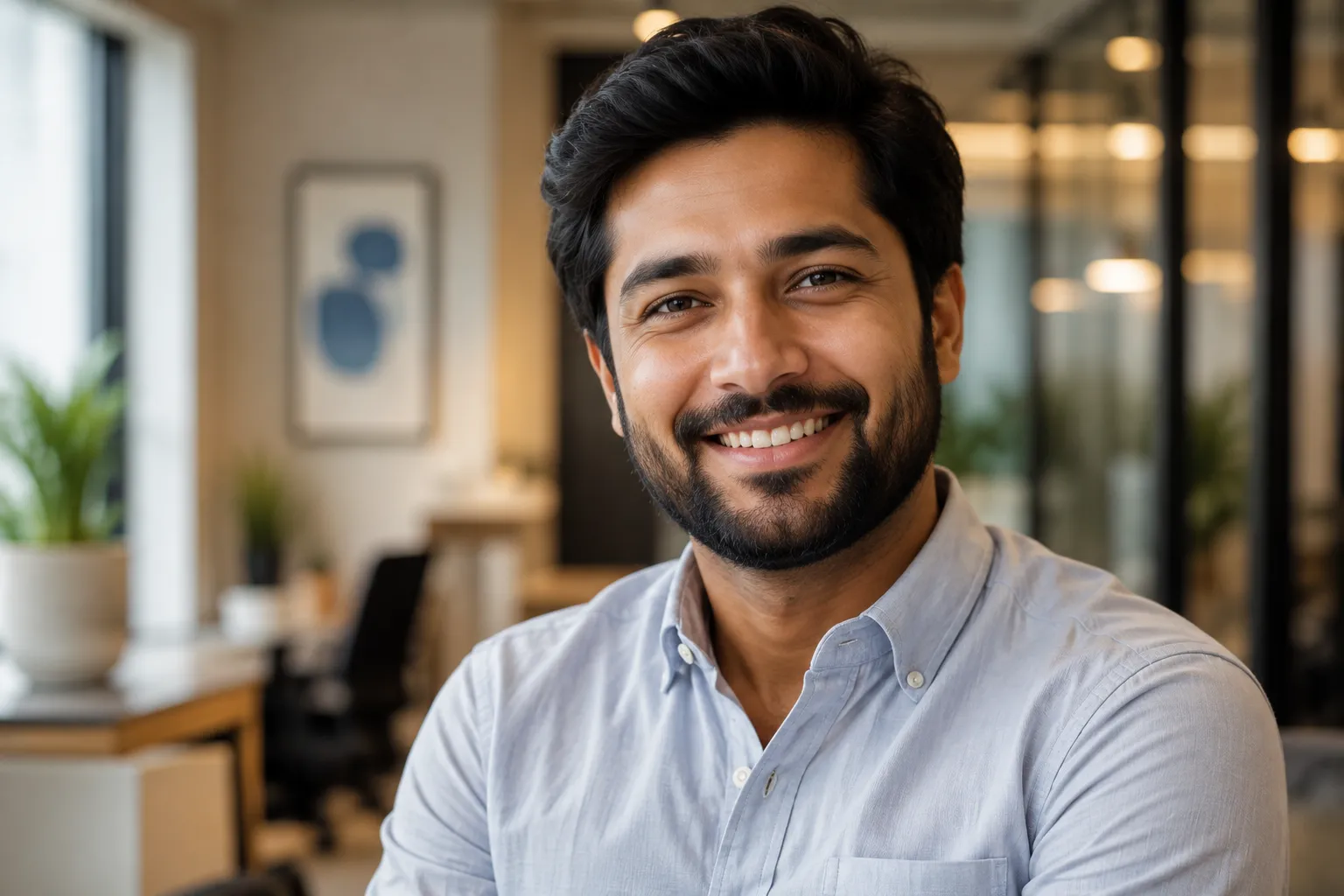
"Am I Too Old for Braces?" — No, and Here Is Why
This is one of the most common questions we hear from adults in their 30s, 40s, and beyond, and the honest answer is that teeth can move at any age, because the biological process (bone resorption and deposition) does not stop working as you get older. A significant and growing share of our orthodontic patients are adults.
What Is Different for Adults
- Jawbone is fully mature, so treatment may take slightly longer than the same case in a teenager
- Existing dental work (crowns, missing teeth, gum recession) needs to be factored into the plan
- Adults are strong candidates for ceramic braces, lingual braces, or Invisalign due to workplace or social considerations
- Adult compliance with retainers and aligner wear is typically higher, which improves outcomes
Why Age 7 Matters for Children
- The American Association of Orthodontists recommends a first orthodontic assessment by age 7
- At this age, a mix of baby and permanent teeth allows early detection of crossbite, crowding, or jaw growth problems
- Early interceptive treatment can guide jaw growth, sometimes preventing the need for extractions or surgery later
- Not every 7-year-old needs treatment immediately — many are simply monitored until the timing is right
Life With Braces — What Changes Day to Day
Eating With Braces
Avoid hard foods that can snap a bracket off: hard candy, ice, whole apples and carrots (cut them instead), nuts, and hard bread crusts. Avoid sticky foods that pull brackets loose or wrap around wires: chewing gum, caramel, toffee. Everything else, cut into manageable pieces, is generally fine. Invisalign patients have it easier since the aligners are removed before eating, but must brush and clean trays before going back in.
Cleaning With Braces
Brackets and wires create more places for plaque to hide, which raises decay and gum inflammation risk if brushing is not adjusted. We recommend an orthodontic toothbrush or electric brush, an interdental brush to clean around and under wires, and a water flosser for patients who struggle with traditional floss threading. Professional cleanings every 6 months become even more important during orthodontic treatment.
Broken Bracket or Poking Wire
If a bracket comes loose but the wire is still holding it roughly in place, this is not an emergency, though it should be fixed at your next visit or sooner if uncomfortable. If a wire is poking and irritating the cheek, cover the end with orthodontic wax immediately, or in a pinch a small piece of sugar-free gum. Do not cut the wire yourself. If pain is significant or a piece could be swallowed, contact us. All three clinics are open until 11PM for exactly this reason.
Sports, Instruments, and Braces
Contact sports require a custom mouthguard fitted over braces — never a generic boil-and-bite guard, which does not accommodate brackets properly. Wind instrument players typically adapt within 2 to 3 weeks as the mouth adjusts. Neither is a reason to delay needed treatment.
Your Treatment Journey — From First Visit to Final Smile
Consultation and Diagnostic Records
Digital X-rays, photographs, and a full bite assessment. Dr. Saad reviews your case and discusses which braces type fits your teeth, budget, and lifestyle. You leave with a clear treatment plan and cost breakdown, no pressure to decide immediately.
Preparation
Any needed dental work (fillings, cleanings, extractions if required for crowding) is completed first, so treatment starts on a healthy foundation. For Invisalign, this is when the digital scan for your custom aligner series is taken.
Fitting Day
Brackets bonded to each tooth and the wire placed, or your first set of aligner trays handed over with instructions. This appointment typically takes 60 to 90 minutes for fixed braces.
Active Treatment — Regular Adjustments
Every 4 to 6 weeks for fixed braces, wires are tightened or changed to keep teeth progressing. Invisalign patients change trays themselves every 1 to 2 weeks at home, with in-clinic check-ins roughly every 6 to 8 weeks to confirm progress matches the digital plan.
Debonding — Braces Come Off
Brackets are gently removed, remaining cement polished off, and final photographs taken. Most patients describe this appointment as one of the best of the entire process.
Retention — The Step Patients Skip at Their Own Risk
A custom retainer is fitted immediately. Full-time wear for the first 3 to 6 months, then nightly, often for life. This is not optional. Skipping it is the single most common reason teeth relapse after successful treatment.
Braces Price in Karachi — Transparent, From Rs 120,000
We believe cost should never be a mystery until your first appointment. Here is our honest starting pricing. Your exact quote depends on complexity, confirmed in writing at your consultation before you commit to anything.
| Treatment | Price |
|---|---|
| Assessment | Rs 2,000 — X-rays, photos, bite analysis, written plan |
| Traditional Metal Braces (full course) | From Rs 120,000 |
| Self-Ligating Braces (full course) | From Rs 150,000 |
| Clear Aligners (Generic) | From Rs 150,000 — 3D scanned, locally fabricated |
| Ceramic Braces (full course) | From Rs 180,000 |
| Invisalign (USA Branded) | From Rs 300,000 — USA branded, more precise tracking |
| Retainer Only | From Rs 15,000 |
| Lingual (Hidden) Braces | Quoted after scan — custom fabrication |
Starting prices. Exact quote confirmed in writing after 3D scan and assessment. Valid at all 3 clinics. Included in every full course: diagnostic X-rays and photographs, the braces or aligners themselves, all adjustment visits for the full treatment duration, one retainer, and emergency visits for broken brackets or poking wires.
What Kind of Dentist Is Best for Braces — and Why Patients Pick Dr. Saad
Braces are a two-year relationship with a clinic, not a one-off visit. The best results come from treatment planned by a postgraduate-trained specialist rather than a general dentist working from a generic protocol. Dr. Saad Irfan holds an MDS in Restorative Dentistry and an MSc in Dental Materials from the University of Sheffield, UK, is PMDC registered, and has over 15 years of clinical experience — and he plans and oversees every orthodontic case personally.
5.0★
346 Google reviews — independent, verified
MDS Sheffield
Postgraduate Restorative Dentistry & Dental Materials training
3 Clinics
DHA Phase 5, DHA Phase 8, and Clifton Block 9 — open 9AM to 11PM, 7 days
15+ Years
Clinical experience planning and overseeing orthodontic treatment
We tell you plainly which option suits your case and your budget — including when fixed braces are more predictable than aligners, even if that means recommending the less expensive route. Book an assessment to see your teeth on a 3D scan and leave with a written plan and a clear price.
Where to Get Braces in DHA & Clifton Karachi
All three clinics offer the full range and the same prices. Pick whichever is nearest — each page has that clinic's parking, travel routes, clinicians and opening details.
Braces in DHA Phase 5
Badar Commercial Street 2 — our main orthodontic hub, with the OPG X-ray and lingual braces lab support.
Braces in DHA Phase 8
Khayaban-e-Iqbal Zone A — quieter residential clinic with parking outside and a dedicated aligner review bay.
Braces in Clifton Block 9
Vincy Mall ground floor — step-free access, secure basement parking, highest female dentist availability.
Benefits of Orthodontic Treatment (Braces)
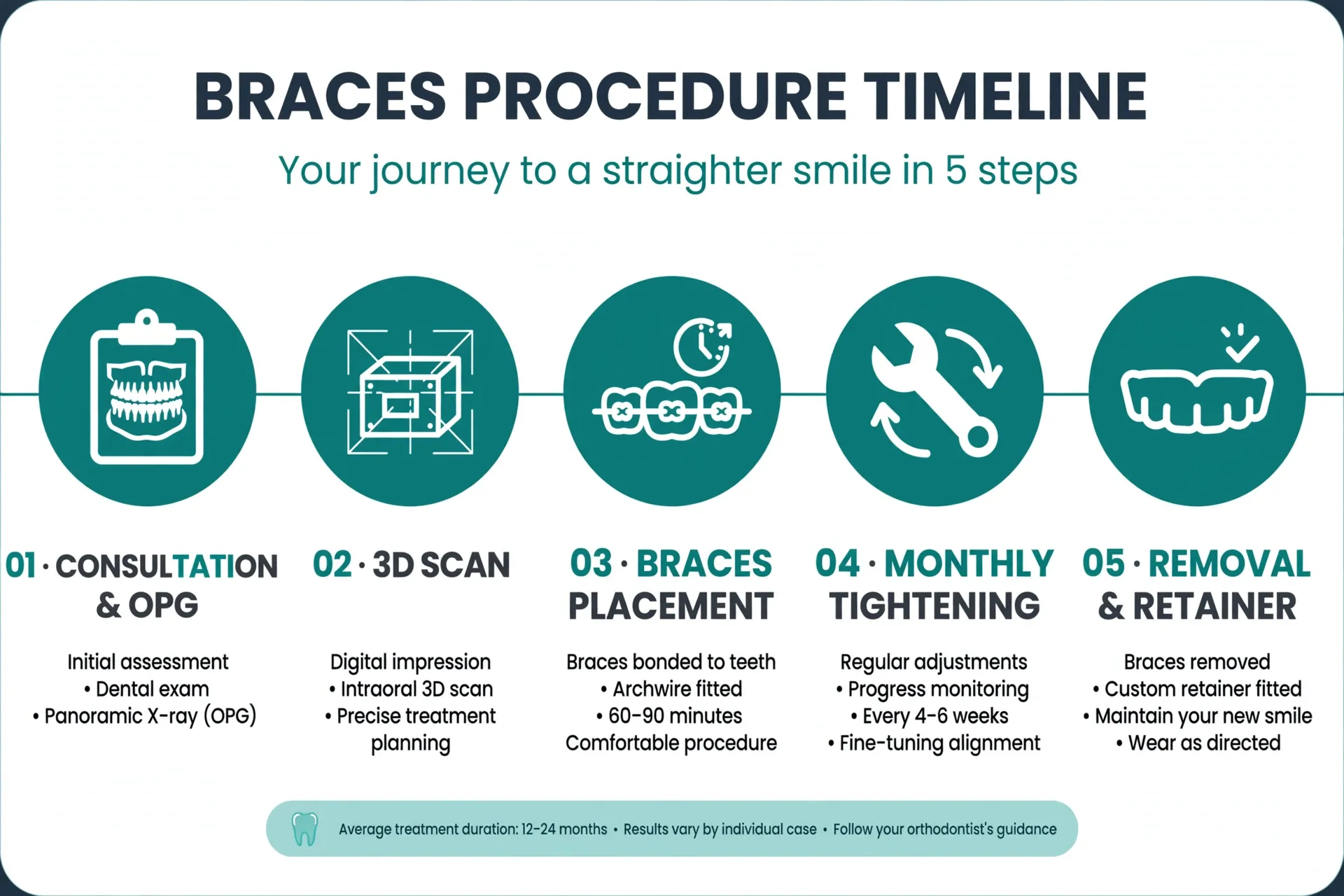
Treatment Procedure
6 stagesConsultation and diagnostic records. Digital X-rays, photographs, and a full bite assessment. Dr. Saad reviews your case and discusses which fixed appliance — metal, ceramic, lingual, or self-ligating — fits your teeth, budget, and lifestyle. You leave with a written treatment plan and cost breakdown.
Preparation. Any needed dental work (fillings, cleanings, extractions if required for crowding) is completed first so fixed treatment starts on a healthy foundation. No aligner scan at this stage — fixed braces use bracket placement, not tray fabrication.
Fitting day — brackets bonded, wire placed. Each bracket is bonded to its tooth and the archwire is ligated. Mild soreness begins 12 to 36 hours later as bone remodelling starts. Fitting takes 60 to 90 minutes.
Active treatment — wire adjustments every 4 to 6 weeks. Ligatures replaced, archwire tightened or upgraded. Mild soreness for 1 to 2 days after each visit confirms teeth are responding. Hygiene instruction at every visit due to fixed hardware.
Debonding — braces come off. Brackets gently removed, remaining cement polished off, final photographs taken. Most patients describe this as one of the best appointments of the whole process.
Retention — the step patients skip at their own risk. A custom retainer is fitted immediately. Full-time wear for the first 3 to 6 months, then nightly, often for life. Skipping it is the single most common reason teeth relapse after successful treatment.
Orthodontic Treatment (Braces) Cost in Karachi
Orthodontic Treatment (Braces) is quoted after examination. No rate card is published — the figure is confirmed in writing at your consultation, priced for a full course, before you commit to any treatment.
Professional Assessment is PKR 2,000
Final cost depends on your specific case. WhatsApp us for a personalised quote.
What moves the figure
Type of braces chosen — metal, ceramic, lingual, or Invisalign
Severity of misalignment — complex cases with large movements take longer
Whether extractions are needed before treatment to create space
Number of aligner trays required (for clear aligner cases)
Why Choose Dr. Saad for Orthodontic Treatment (Braces)?
3D Digital Intraoral Scanner — No Putty Impressions
We use a 3D intraoral scanner instead of traditional putty impressions. No gagging. No waiting. You see your teeth on screen within minutes. The digital model is used to plan tooth movements precisely and design custom aligners and retainers without physical impressions.
Written Treatment Plan with Fixed Cost
You leave your consultation with a written plan that includes the recommended braces type, estimated treatment duration, and total cost. No surprises. No vague ranges. You decide whether to proceed with full information.
MDS Occlusion Expertise
Dr. Saad's MDS training at the University of Sheffield covered advanced occlusion — how upper and lower teeth fit together — and how bite problems affect jaw joint health and tooth wear over a lifetime. Every orthodontic plan addresses not just appearance but long-term bite stability.
Metal Braces quoted after examination
Metal braces are quoted after examination for a full treatment course including all adjustment visits, debonding, and retainer fitting. This is the clearest pricing anchor in the Karachi dental market for orthodontics.
We Recommend Honestly, Even When It Costs a Sale
We have turned away Invisalign requests whose crowding was too severe for predictable aligner results and recommended traditional braces instead. A straight smile that relapses within a year because retention was rushed is not a successful outcome, it is a delayed failure.
DHA Phase 5, DHA Phase 8, and Clifton Block 9 - Open Until 11PM
Adjustment appointments are available 7 days a week at all three clinics. Evening appointments until 11PM make it practical for working adults and school-age patients to maintain their 4 to 6 week schedule without disrupting work or school.
Frequently Asked Questions
346 verified 5-star Google reviews
Across our DHA Phase 5, DHA Phase 8 and Clifton Block 9 clinics. Every review is verified by Google and cannot be edited by us.
Options
Orthodontic Treatment (Braces) Options
Compare treatment options to find the best fit for your needs and budget
Metal Braces
Stainless steel brackets bonded to each tooth with a metal archwire. The most proven orthodontic technology — most effective for complex cases including severe crowding, large overbites, and jaw discrepancies.
Duration
18-30 months
Lasts
Permanent with retainer
Cost
Quoted after examination
Advantages
Most effective for all severity levels including severe cases
Most affordable braces option — full treatment quoted after examination
Modern brackets are smaller and more comfortable than older designs
Decades of clinical evidence
Trade-offs
Most visible — silver brackets on front teeth
Dietary restrictions: avoid hard and sticky foods
Requires interdental brush for proper cleaning around brackets
Best for
Complex cases, children, patients prioritising effectiveness and cost
Ceramic Braces
Tooth-coloured aluminium oxide ceramic brackets bonded in the same way as metal braces. Nearly the same effectiveness as metal braces with a much less visible appearance. A popular discreet option.
Duration
18-30 months
Lasts
Permanent with retainer
Cost
Confirmed at consultation
Advantages
Tooth-coloured brackets blend with enamel — highly discreet
Same clinical effectiveness as metal braces for most cases
Brackets resist staining when properly maintained
Effective for most cases
Trade-offs
Slightly larger bracket than metal — some patients notice this
Priced individually at consultation
Dietary and hygiene requirements same as metal braces
Best for
Adults and teenagers wanting effective treatment without the metal look
Lingual Braces
Fixed brackets placed on the inside (tongue-facing) surfaces of the teeth rather than the front. Completely invisible when smiling. Custom bracket fabrication required for each patient.
Duration
18-30 months, occasionally longer
Lasts
Permanent with retainer
Cost
Confirmed at consultation
Advantages
Completely hidden — invisible from outside
Fixed treatment — no compliance issues
Same effectiveness as standard fixed braces
Trade-offs
Custom fabrication at premium pricing
Initial tongue discomfort during adjustment period
Harder to adjust and clean than standard braces
Best for
Adults in public-facing roles who want zero visible sign of treatment
Invisalign Clear Aligners
Series of custom-made removable transparent plastic trays planned using 3D digital intraoral scanning. No brackets, no wires. Remove to eat, drink, and brush. Changed every 1 to 2 weeks.
Duration
12-24 months depending on case
Lasts
Permanent with retainer
Cost
Quoted after examination
Advantages
Virtually invisible — no brackets or wires
Fully removable: no dietary restrictions
Easy oral hygiene — brush normally with trays out
Planned with 3D scan at Dr. Saad's clinic — no putty impressions
Trade-offs
Must be worn 20 to 22 hours per day for results — requires discipline
Less effective than braces for severe cases or large vertical movements
Pricing depends on tray count — quoted after scan
Best for
Adults with mild to moderate misalignment, professionals, patients wanting no visible hardware
Self-Ligating Braces
Fixed brackets with a built-in sliding mechanism that holds the archwire without elastic ligatures. The door clips shut instead of being tied in, which reduces friction on the wire and often means fewer adjustment visits and a more comfortable fit than conventional brackets.
Duration
18-30 months
Lasts
Permanent with retainer
Cost
Confirmed at consultation
Advantages
Fewer adjustment appointments than conventional braces
Less friction and pressure on teeth — often more comfortable
Easier to clean around the bracket without elastic ties
Available in discreet tooth-coloured ceramic versions
Trade-offs
Bracket is slightly larger than a conventional bracket
Priced individually at consultation
Same dietary care needed as other fixed braces
Best for
Patients wanting fewer visits and a more comfortable fixed-brace experience
Recovery
Orthodontic Treatment (Braces) Recovery Timeline
What to expect during your recovery
Fitting Day and First Week
7 daysBrackets bonded in 60 to 90 minutes. Soreness begins 12 to 36 hours later and lasts 2 to 4 days as teeth begin moving. Cheek irritation from new brackets is common in the first week and managed with orthodontic wax.
Aftercare
Soft foods for the first 3 days — yoghurt, rice, daal, soft bread
An over-the-counter anti-inflammatory about an hour before adjustment appointments, as directed on the packet
Cold foods and drinks in the first 48 hours reduce inflammation
Orthodontic wax on any bracket irritating your cheek
Active Treatment Phase
18-30 months (adjustment every 4-6 weeks)Each adjustment appointment replaces ligatures and tightens or upgrades the archwire. Mild soreness for 1 to 2 days after each visit is normal and confirms teeth are responding. Visible tooth movement becomes apparent after the first 2 to 3 months.
Aftercare
Brush after every meal — minimum 3 times daily with braces
Use interdental brush under the archwire between brackets
Use fluoride mouthwash once daily to reach areas the brush cannot
Avoid hard foods (nuts, ice, hard bread), sticky foods (chewing gum, caramel, paan masala)
Report any loose or broken bracket immediately — do not wait for your next appointment
Retention Phase (After Braces Removal)
OngoingRetainer fitted on the same day braces are removed. Worn full-time for 3 to 6 months, then every night long-term. Bone takes months to fully stabilise around teeth in their new position. Stopping retainer wear early risks losing the treatment result.
Aftercare
Wear retainer every night without exception
Store retainer in its case when not in your mouth
Clean retainer with a toothbrush and cold water daily
Return for a check-up every 6 months
Replace retainer if it cracks or no longer fits — contact us immediately
Cost Breakdown
Orthodontic Treatment (Braces) Cost in Karachi
Transparent pricing. No hidden costs.
Every item above is covered by the written quote you get after your examination. Ask us for an estimate on WhatsApp.
Get Personalized Quote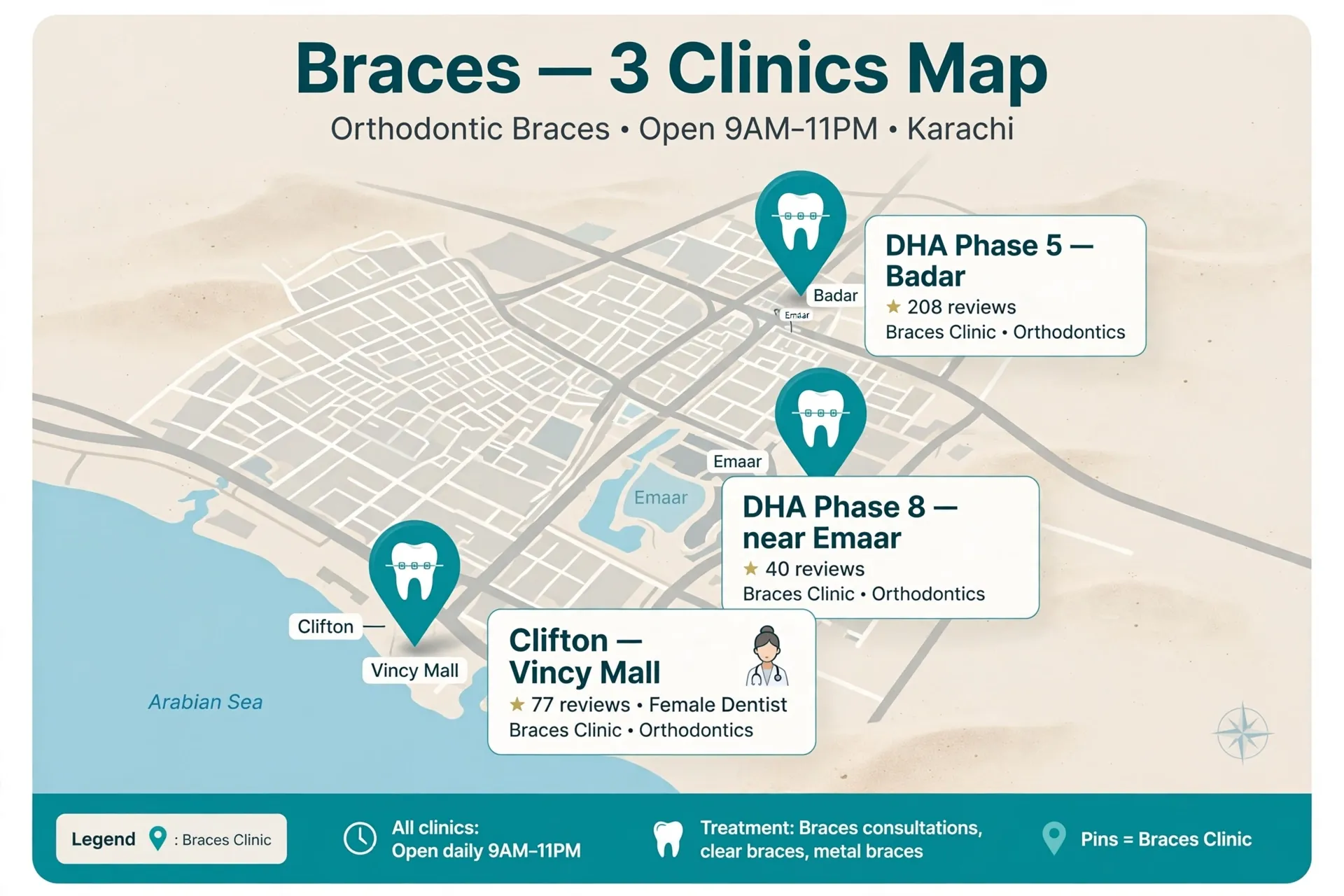
Where to get braces in Karachi
We run three clinics across two areas of Karachi, all open 9 AM to 11 PM every day. Pick the area you are in and the hub page will tell you which clinic is nearest.
Plot 4-C, Shop 2, 5 Badar Commercial Street 2, Badar Commercial Area, Phase 5, DHA
+92 313 3466661 · Open 9AM-11PM, 7 days a week · 5.0★ (229 reviews)
H#202/2, 21 Street Khayaban-e-Iqbal, DHA Phase 8 Zone A
+92 313 3466661 · Open 9AM-11PM, 7 days a week · 5.0★ (40 reviews)
Shop No. 6, Ground Floor, Vincy Mall, Block 9, Clifton
+92 334 3930986 · Open 9AM-11PM, 7 days a week · 5.0★ (77 reviews)
Medically reviewed byDr. Saad Irfan— MDS, MSc, BDS·
Medical Disclaimer: This content is for informational purposes only and does not constitute medical advice. Always consult a qualified dentist for diagnosis and treatment specific to your condition. Results may vary depending on individual cases. Dr. Saad Irfan Dentistry, Karachi.
Consultation
Open 9AM to 11PM, seven days a week.
Consultation fee PKR 2,000 · WhatsApp bookings confirmed within two hours.